Jan Assmann: Cultural Memory vs. Communicative Memory Explained
The difference between cultural and communicative memory, the "Floating Gap," and why Jan Assmann's theory matters for memory studies.
Key Takeaways
- Communicative memory is informal, oral communication shared across three generations, typically lasting eighty to one hundred years.
- Cultural memory preserves foundational history through institutionalized rituals, monuments, and texts across centuries or millennia.
Most family stories disappear within a few generations, typically within 80 years. Yet, we still "remember" the Exodus, the Odyssey, or the French Revolution. This is the effect of cultural memory, a mechanism that enables civilizations to preserve memories essential to their cultural identity. The theory was first presented in the early 1990s by German Egyptologist Jan Assmann and Aleida Assmann.
Communicative Memory vs. Cultural Memory
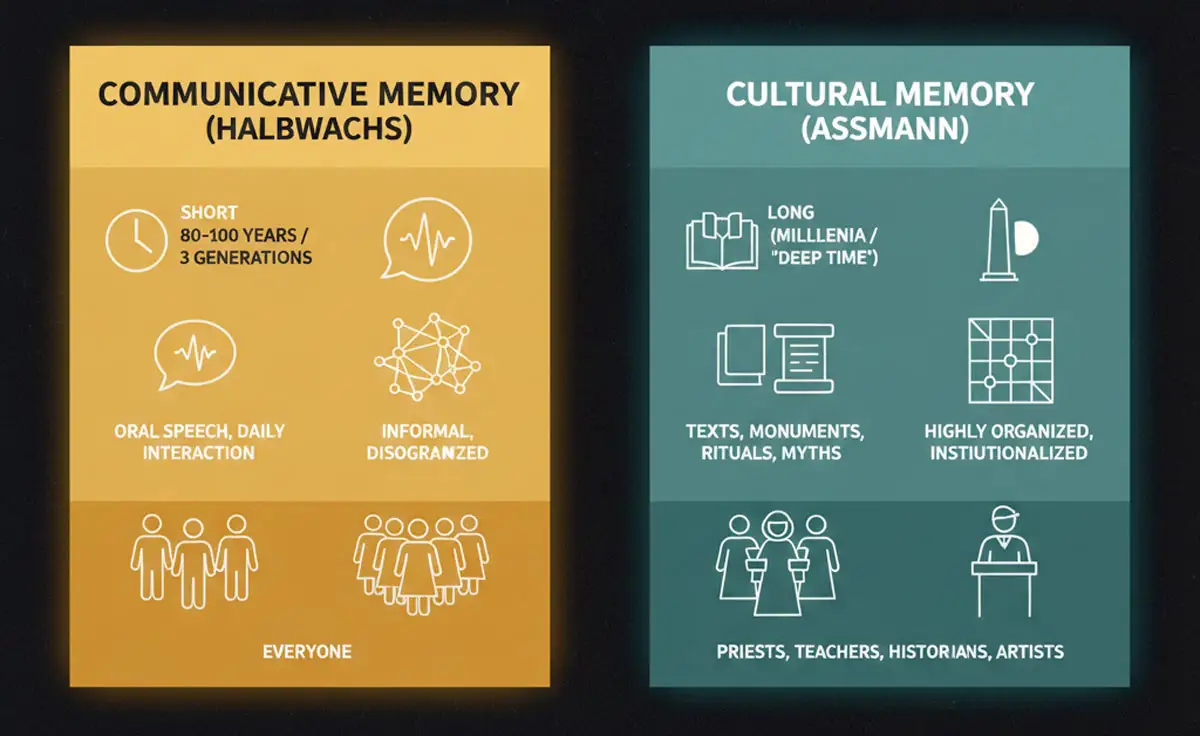
| Communicative Memory (Halbwachs) | Cultural Memory (Assmann) |
| Short (80–100 years / 3 generations) | Long (Millennia / "Deep Time") |
| Oral speech, daily interaction | Texts, monuments, rituals, myths |
| Informal, disorganized | Highly organized, institutionalized |
| Everyone | Priests, teachers, historians, artists |
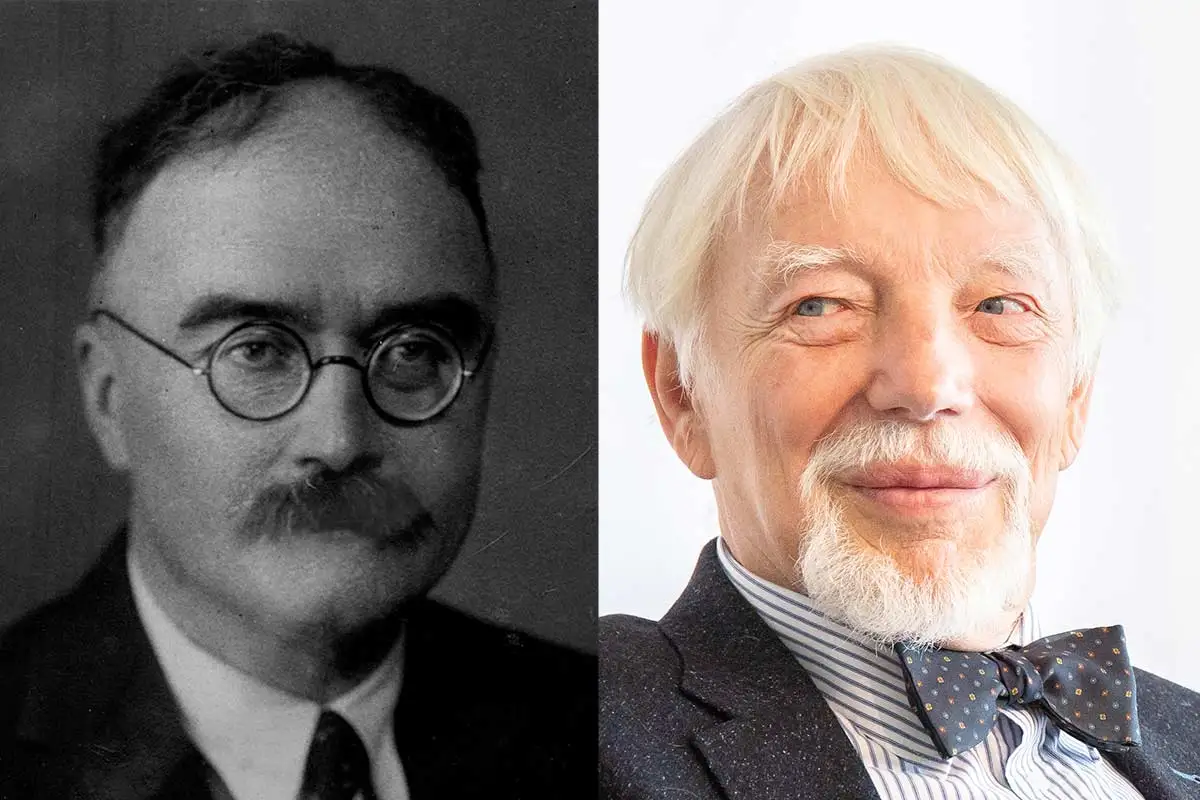
Assmann's cultural memory is a concept that builds on an older one, that of collective memory.
Maurice Halbwachs, a French sociologist of the previous century, argued that memory was a social process. According to Halbwachs, a group of people form networks of memories that shape the group's collective identity, like a group of Greek immigrants in the US is brought together by a shared memory of the homeland.
For Assmann, Halbwachs' collective memory was based on oral speech and daily interaction and had a span of ca. three generations. Think of a family and its ability to maintain memories of its ancestors. In Das Kulturelle Gedaechtnis (1992), Assmann called this communicative memory.
Assmann claimed that cultures employ a form of memory that is highly organized and thus able to remain intact for hundreds, if not, for thousands of years in what Fernand Braudel and the Annales termed the longue durée. Assmann called this cultural memory because it acts as the glue that holds together a culture.
How Cultural Memory Works

Cultural memory is the form that memory takes when it attempts to "remain alive" beyond a person's lifespan and become a constant reference for various groups of people. Cultural memory can take the form of monuments, texts, and rituals which hold together memories important for the existence of a culture.
Assmann believes that for a civilization to exist, certain cohesive structures are required. These structures must be able to preserve memories of the past and activate them in the present. Rituals, such as those that take place during Thanksgiving or the 4th of July, for example, are essential in this. During an Independence Day Parade those participating "relive" the memory of American Independence, in the same way in which those attending Easter celebrations are "reliving" the memory of Christ's crucifixion and resurrection.
Cultural memory is also kept alive in symbols (e.g. the Eye of Horus for an ancient Egyptian or the cross for a Christian), as well as in texts, representations, and monuments.
Institutionalized and Highly Organized
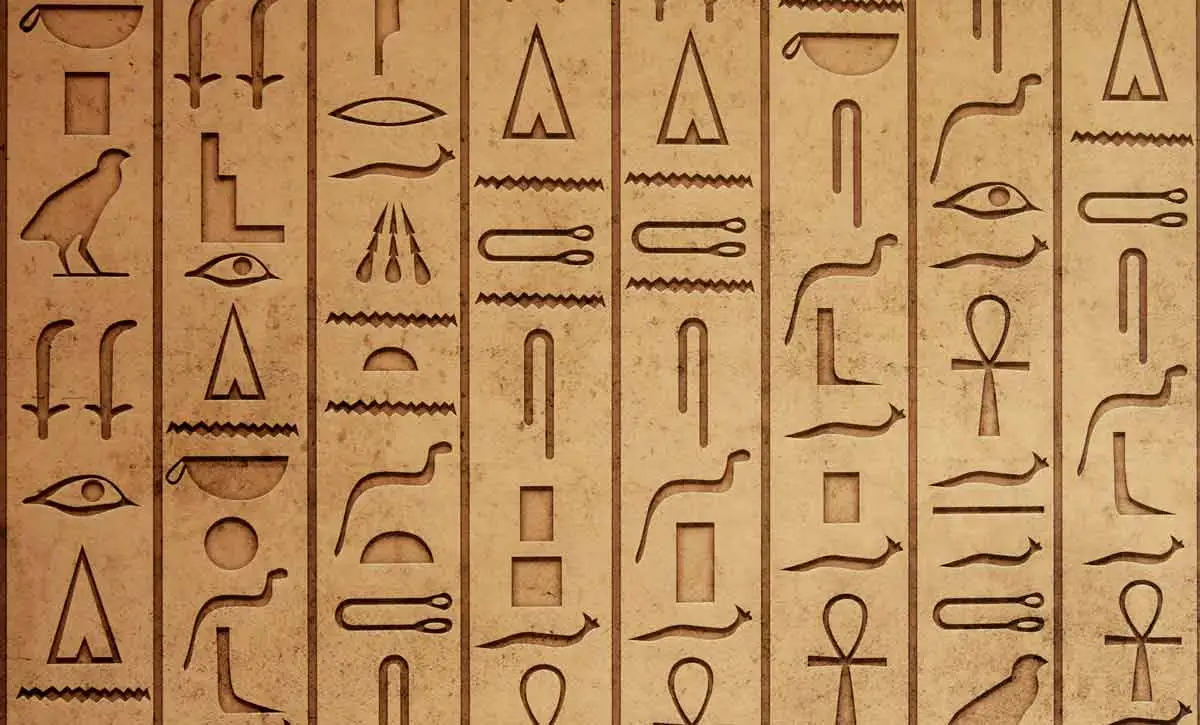
What you need to keep in mind, is that cultural memory is institutionalized and highly organized. Think of ancient Egypt for example, a civilization that managed to preserve memories that held together a common identity for almost 3000 years. Writing in the form of hieroglyphics was accessible only to the a specific class of priests who could read and write, essentially safeguarding the knowledge of the past.
Key Terms: Canon, Archive, Floating Gap
If you are interested in reading Assmann's work, here are some additional key terms you need to know:
- The Canon: The "active" memory. The stories we tell every year (e.g., museum exhibitions, National Holidays, Religious texts).
- The Archive: The "passively stored" memory. Memories we don't bring to the present, e.g. objects in museum storerooms. Aleida Assmann has expanded on the relationship between canon and archive.
- Floating Gap: Although the term "floating gap" was coined by Assmann, the phaenomenon was first observed by anthropologist Jan Vansina in 1965. The floating gap refers to the "empty" mnemonic space that exists between the recent past still remembered (communicative memory) and the distant past (usually the mythical or foundational history of a group). The gap is floating because it constantly moves. There is plenty of information about the distant past and the last 80 years, but little to no recollections about the in betweeen space. (see Gebhardt Fink 2014 for more)
Bibliography
- Assmann, J. (2011). Cultural Memory and Early Civilization: Writing, Remembrance, and Political Imagination. Cambridge: Cambridge University Press.
- Assmann, A. (2008). Canon and Archive. In A. Erll, & A. Nünning (Eds.), Cultural Memory Studies: An International and Interdisciplinary Handbook. Walter de Gruyter.
- Gebhardt Fink, S. (2014). 'Floating Gaps. Considerations on the Basel Performance Chronicle, Part I'. Publication Series of the Academy of Fine Arts Vienna, 13. p. 42-49. https://doi.org/10.21937/9783956790539.4