Benedict Anderson's Imagined Communities: Summary & Key Terms
A breakdown of Benedict Anderson’s theory of the nation as an imagined community, print capitalism, and why this matters.

Summary
- Definition: Anderson defines the nation as an "imagined community" because members will never meet most of their fellows, yet they share a mental image of their communion.
- Print Capitalism: The mass production of books and newspapers in the vernacular (common language) allowed disparate groups to communicate and see themselves as part of a single, unified discourse.
- A Modern Construct: Contrary to theories suggesting nations have ancient roots, Anderson places the nation’s birth during the Industrial Revolution.
In his landmark "Imagined Communities: Reflections on the Origin and Spread of Nationalism" (1983), the Anglo-Irish historian Benedict Anderson claimed that the nation is an imagined community.
But what did he mean by that term?
A Modernist Understanding of the Nation
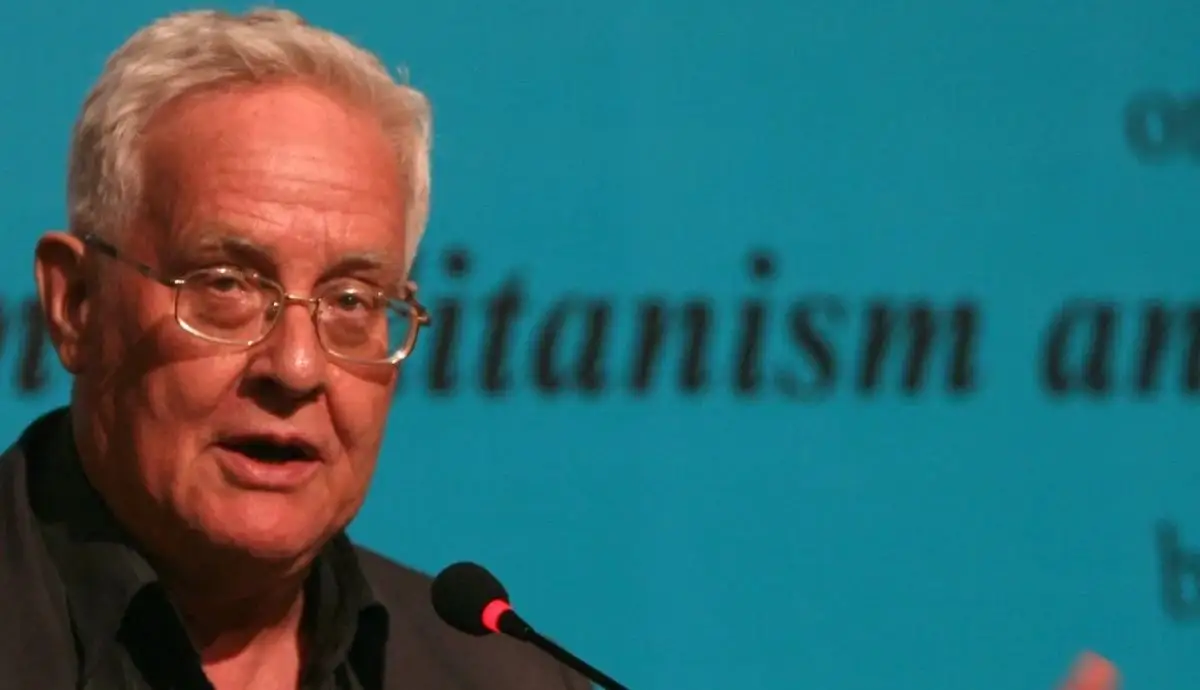
In his work, Benedict Anderson studied nationalism across time and space and came to the conclusion that the nation is not a naturally occurring phenomenon, but a socially constructed "imagined community."
This is a position he shared with other theorists of modernism (such as Hobsbawm). Later movements that critiqued modernism, such as Anthony D. Smith's ethnosymbolism, agreed with Anderson that the nation is a modern construct but argued that it is based on prior "ethnic" roots.
The Three Traits of an Imagined Community
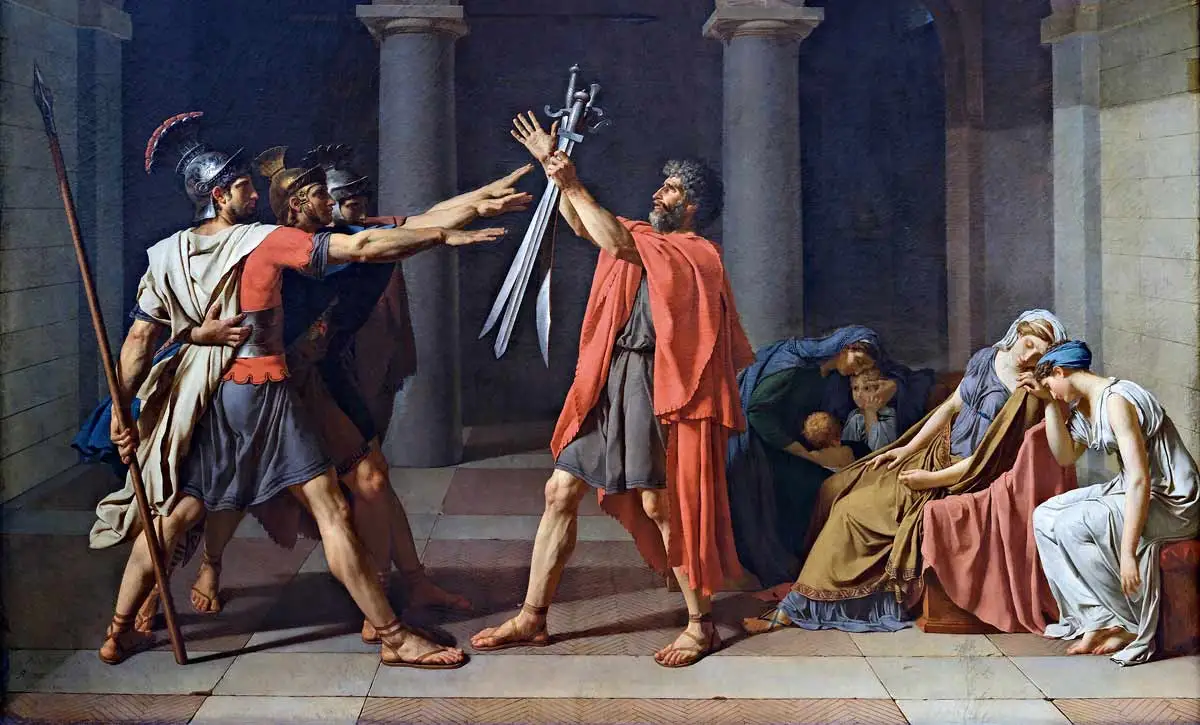
According to Anderson, every nation shares three fundamental characteristics:
- Limited: Even the largest nation has finite, if elastic, boundaries. It does not encompass all of humanity; it ends where another nation begins.
- Sovereign: The concept emerged during the Enlightenment, replacing the idea of "divinely-ordained" monarchies. The nation is the ultimate authority over itself.
- Community: Regardless of actual inequality or exploitation, the nation is always conceived as a deep, horizontal comradeship.
Anderson looked at the processes that took place at the onset of the Industrial Revolution, specifically the decline of divine, Medieval-like monarchies (think of the Holy Roman Empire) and the emergence of what he called "print capitalism". The last one is particularly important.
What Is Print Capitalism?
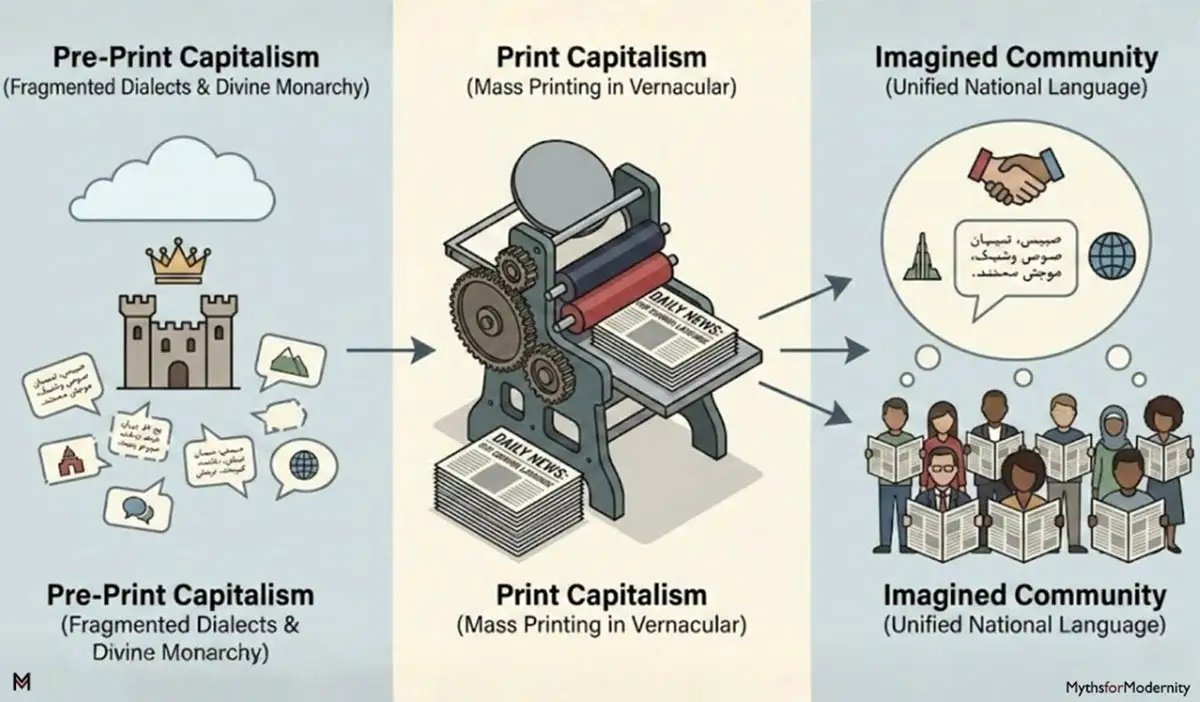
Benedict used the term "print capitalism" to describe a capitalist market that shapes a common language and discourse through the mass printing and distribution of the press in the vernacular (ordinary spoken language) to maximize its reach. This way, print capitalism shapes a community able to understand a commonly accepted version of the vernacular and not one divided by a multitude of dialects.
So, Why Is the Nation "Imagined?
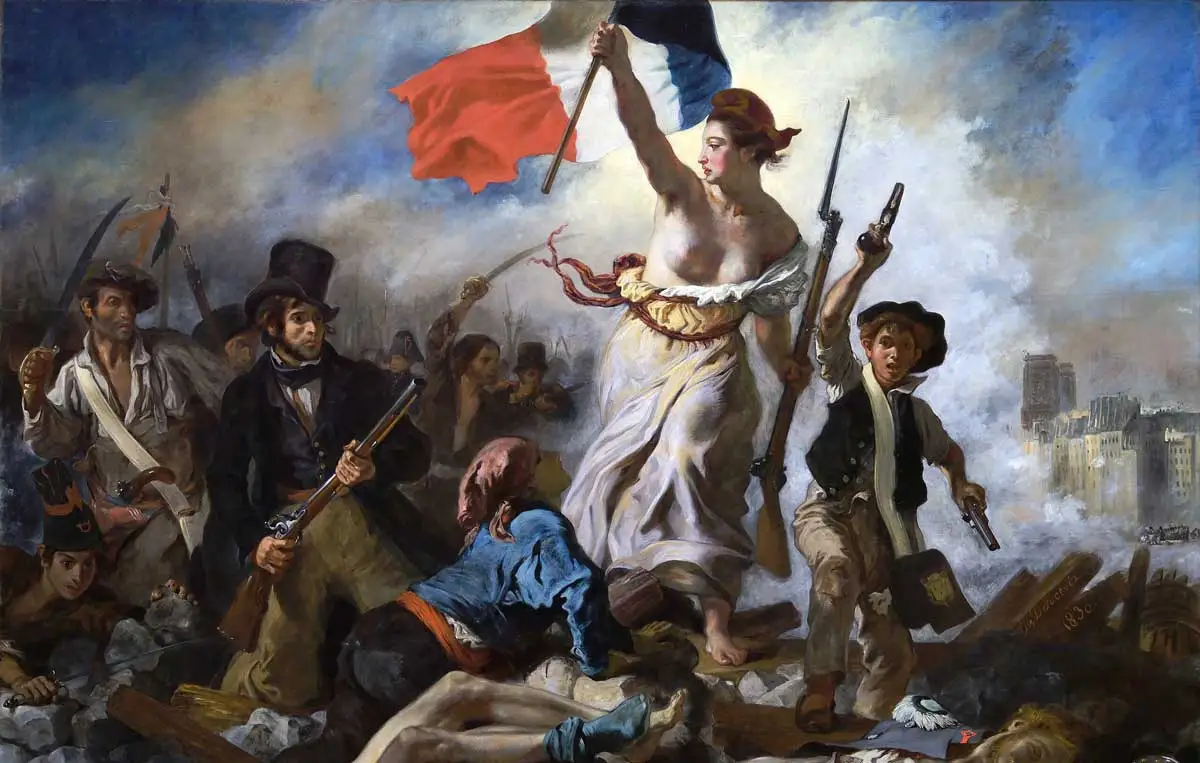
Anderson answers the questions in simple terms:
"[the nation] is imagined, because the members of even the smallest nation will never know most of their fellow-members, meet them, or even hear of them, yet, in the minds of each lives the image of their communion."
And Why Is It a "Community"?

Because for those who participate in it, "the nation is always conceived as a deep, horizontal comradeship."
It is exactly this idea of comradeship that makes it possible for someone to give their life to protect someone they have never met, and it is exactly that which, according to Anderson, makes the nation so persistent.
The Nation as an Imagined Community

According to Anderson, the nation emerged recently and is both limited, in that it has limits, and sovereign, in that no single monarch can claim the nation for themselves, as happened in the past.
Anderson describes beautifully how the imagined community of the nation takes shape as one reads the news in the newspaper:
"It is performed in silent privacy [the reading of the paper], in the lair of the skull. Yet each communicant is well aware that the ceremony he performs is being replicated simultaneously by thousands (or millions) of others of whose existence he is confident, yet of whose identity he has not the slightest notion."
Ernest Gellner vs. Anderson
In Nations and Nationalism (1983), Ernest Gellner claimed that nationalism appeared as a modern necessity arising from economic conditions such as the creation of factories. Under industrial capitalism, the elites require a homogenous cultural body that can operate factories and sustain the economical growth that the State requires.
Anderson's theory, as discussed goes beyond the economy. Anderson asks: why does someone die for the nation? His answer was an imaginary community conceived as a horizontal comradership through the connection provided by Print Capitalism. Thus the nation did not arise from economic necessity only, but mostly through a new media culture.
Eric Hobsbawm vs. Anderson
Eric Hobsbawm's Invention of Tradition (1983) is often cited next to Anderson's work as a modernist theory about nationalism.
Hobsbawm's work focused on how elites "invent" traditions, like national anthems, national attire, public rituals, and others, while claiming that they are ancient to provide the nation with a sense of historic continuity and ensure social cohesion.
For Anderson the nation is not fake or invented; it is imagined. The horizontal comradeship he writes about is real, but a strong imaginary sense of belonging.
Keep in mind that you do not need to select one theory. Gellner, Hobsbawm, and, of course, Anderson are complementary and offer a different perspective in the study of the nation. Depending on your angle and research, these theories can become useful tools. There are many more "tools" you can use, but that is a topic for another article that will try to bring multiple theories together.
Further Reading
- Anderson, B. (1983). Imagined Communities: Reflections on the Origin and Spread of Nationalism. Verso.
- Gellner, E. (1983). Nations and Nationalism. Cornell University Press.
- Hobsbawm, E. J., & Ranger, T. (Eds.). (1983). The Invention of Tradition. Cambridge University Press.
- Smith, A. D. (1986). The Ethnic Origins of Nations. Blackwell.
Also read: Necropolitics vs. Biopolitics: Mbembe's Reinterpretation of Foucault.