You Are Odysseus: A Choose-Your-Own Homeric Adventure with Laura Jenkinson-Brown
How many ways can the Odyssey end? Teacher, illustrator, and author Laura Jenkinson-Brown talks about her work that turns the Homeric epic into an interactive multiverse.
In this conversation
- Why Odysseus is the only ancient hero equipped to survive a "multiverse."
- How LJB mapped the 51 different endings of "You Are Odysseus".
- The role of kleos, aidos, and nostos.
- Why Odysseus was a "complicated man".
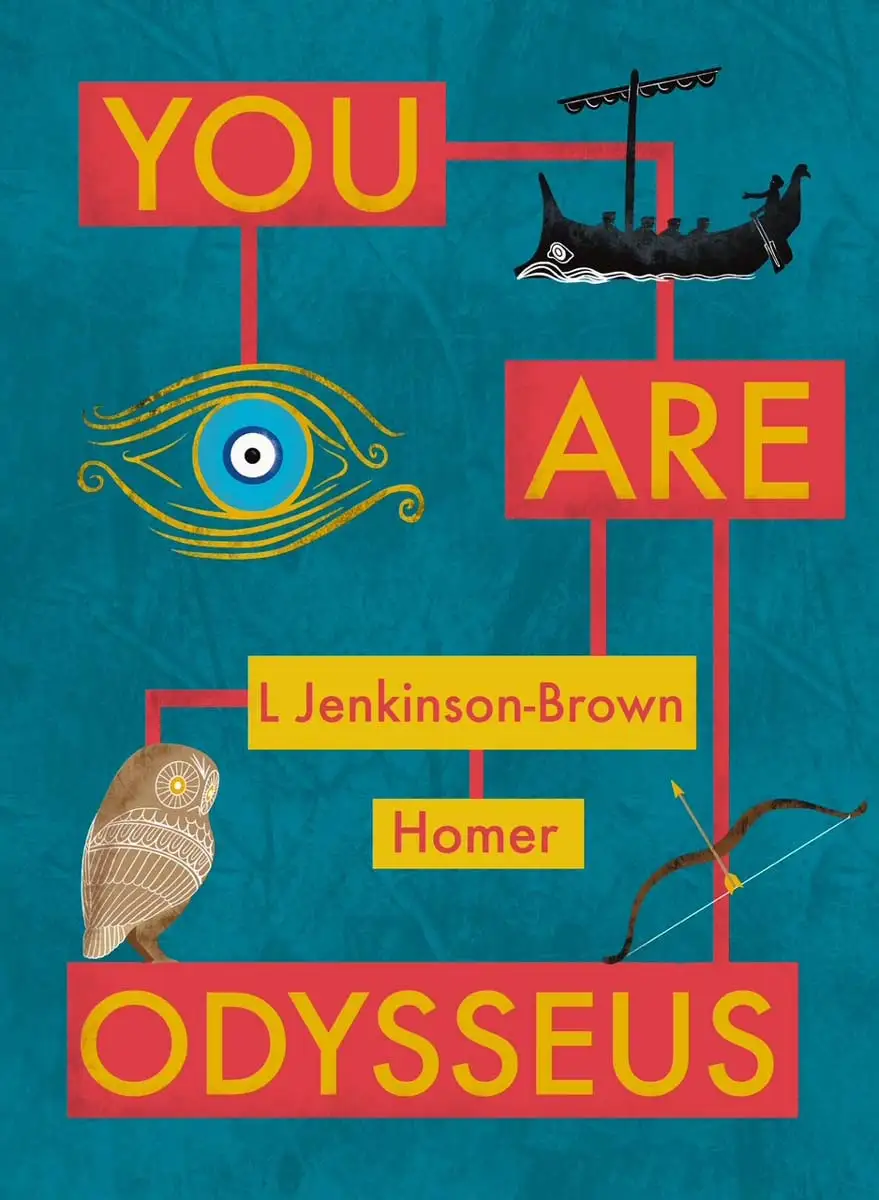
Laura Jenkinson-Brown is the creator behind Greek Myth Comix and the author of You Are Odysseus, an interactive adaptation of Homer’s Odyssey available in paperback, ebook, and as an audiobook podcast. We discussed the logistical nightmares of mapping out a Bronze Age choose-your-own-adventure, the true meaning of polytropos, and why Odysseus is the only ancient hero suited for a multiverse.
AC: Tell me, O Laura Jenkinson-Brown, the story of that resourceful man you adapted under the title You Are Odysseus.
LJB: Well, it’s the Odyssey—and we don’t have space to summarise that here, and probably not the need either! But, if you make different choices to the ones Odysseus makes, you’ll end up on a slightly or very different adventure within the text and the mythology of the Epic Cycle and the Bronze Age Mediterranean. It’s also the viewpoint of Odysseus only, as you embody that character, so you see it all from his point of view instead of Homer’s omniscient poet narrator.
AC: You Are Odysseus is impressive in its breadth and length with multiple different paths the reader can choose from. Can you walk us through the logistical challenges of mapping out a choose-your-own-adventure story on this scale?
LJB: Initially I planned it out on paper, and then massive rolls of paper. Then I found an old bit of software that was the equivalent of post-it notes and string, and that helped a lot as I got into the bigger numbers—I’m dyscalculic and my brain does odd things with numbers. But I still ended up plotting it out on massive rolls of paper at the same time, just to ensure it worked.
If you looked at a graphic of all the connections it would look like a map of a very complicated set of tree roots. There are fifty-one possible endings: some are variations on the original, others are variations on a theme depending on where your character was going and developing.
For example, if you end up on a completely different adventure, or if you take longer to get home and miss the window on Ithaca that will let you take back your family and throne. Some are straight-out deaths from bad choices, but most give you an idea of what kind of notoriety you will gain from having made that final choice.
The audiobook podcast version that is about to release its second half is simpler in that it focuses on just the main Odyssey storyline, but still allows you to consider the choices in the moment, before carrying on with Odysseus’ actual choice.
AC: Why the Odyssey specifically? Why not another epic, like the Iliad or the Aeneid, or a tragedy?
LJB: Because of Odysseus. He is the only ancient hero known outright for his cleverness and consideration of the scenario. We are told in the text "his mind went this way and that" or "he pondered" before he makes a decision, and that allows us to consider what he’s considering, working out the possible endings from each scenario available to him.
The book is kind of like a multiverse focusing on Odysseus, where each choice spins off into a new reality and might lead him away from the story we already know, or back to it.
Also, I teach the Odyssey, and originally it seemed like it would make a good exercise in understanding his character and why he makes the decisions he does. The book starts with a reminder to the reader to think like Odysseus and the Homeric heroes, making their decisions with xenia (law of hospitality), kleos (enduring fame), aidos (acting in a shameful way) and nostos (wanting to get home) rather than modern ideas of morality or what’s right.
In the audiobook podcast version of the book, these are repeated at the start of every episode to constantly drum home these important themes.
Kleos, Kudos, and Mechanics
AC: Kleos and kudos form the backbone of the narrative, acting as the two principles that guide Odysseus and the reader’s actions. Could you briefly explain these concepts and how you approached integrating them into the mechanics?
LJB: Kudos is the things you do that gain you good reputation, with aidos, shameful action, being like the opposite of that—you’ll be infamous rather than famous. Kleos is the everlasting fame you get from gaining kudos throughout. But xenia, giving and receiving hospitality in the correct way, is even more integral to the Odyssey itself, sorting the "good guys" from the "bad guys" by looking at how they approach this, which is sacred to Zeus himself.
The Odyssey’s plot mostly follows these themes so they’re already there in the main storyline, but in the additional storylines you can end up on, they’re still integral.
AC: Is there a specific ending you particularly favor?
LJB: I have to admit having a soft spot for the version of the story where Odysseus chooses to sail home with Menelaus, and ends up rather surrendering his agency to his friend—and following the story of his travels that Menelaus tells Telemachus in Book 4 of the Odyssey. I loved researching Bronze Age Egypt and the somewhat complimentary areas of mythology between Egypt and Achaea.
There are also nods to the Aeneid’s comparative mythology in that section, with Tyre being a destination. And, it also allowed me to make Helen even more of a character than she is in the Odyssey.
But for the audiobook podcast, I think my favourite section has to be the underworld—which is included in its fullness with all the tales of the great women of myth that most retellings leave out—which allowed me to play with some fantastic sound effects to create a really satisfyingly spooky atmosphere.
AC: Mine was undoubtedly the Greek tragedy ending. I won’t spoil it for our readers, but it’s one of these endings in the book where Odysseus reaches Ithaca and faces an alternative ending presented in the format of a traditional tragedy, complete with a chorus.
LJB: I’m so glad you enjoyed that one! I’m really proud of it. I really love Greek tragedy and really wanted to include a cathartic, awful ending for Odysseus if he wasn’t careful, didn’t follow Athena’s guidance and lost her patronage, and just barelled into Ithaca all guns blazing as it were.
I’ve made a special episode of the audiobook podcast with the tragedy as a performance, because Ancient Greek plays should always be experienced as performance rather than just reading where possible, and I really can’t wait to launch that at the end of season 2!
AC: What role do the gods play in the interactive world of You Are Odysseus?
LJB: Very much the same as in the Odyssey, with Athena appearing to Odysseus and guiding him directly, and Hermes helping him with Circe and Calypso.
But, as you only have the viewpoint of Odysseus, you don’t always see or hear about the presence of the gods, and you’re only privy to what they allow you to directly experience. The introduction emulates the invocation to the muse at the start of the poem, with Calliope being suggested as the narrator.
The Complicated Man
AC: In your epilogue, you list multiple translations of polytropos, noting Emily Wilson’s "complicated man" (which also inspired Christopher Nolan’s recent film adaptation). Which translation of polytropos is your personal favorite, and did it affect your vision while writing this project?
LJB: Odysseus is rather hard to pin down to one definition, and while some translations are adjectives of his personality, others describe the way he does things. All together, they present a more understandable character, so I didn’t favour any one overall. But I do think "complicated" is quite a handy catch-all.
I ask the reader to consider what kind of Odysseus they are going to be, by using the Epic Cycle story of he and Diomedes stealing the palladium from Troy and the different versions of the story that exist of what happened afterwards. Hopefully though they come to realise that you can’t be a "good" or a "bad" Odysseus—he is truly complex and responds to the situation within the framework of kleos, aidos, xenia and nostos.
AC: What were your thoughts on Nolan’s film adaptation of the Odyssey?
LJB: Well, his Odysseus was certainly not complicated. And having watched most of the film and series adaptations out there, I think he adapted those rather than the Odyssey itself.
AC: How does the visual style you developed for Greek Myth Comix complement the branching narratives of the story?
LJB: I didn’t actually use my stickman Greek Myth Comix style for the book, but I did illustrate sections of it and create a map for it, in a line-art style that references Bronze Age, Archaic and Classical Greek art representations of the Odyssey and its characters.
I like to think that Classicists will get the references and non-Classicists will get them if they encounter the original material, and for both sets of readers the illustrations help you focus in on the atmosphere of the text.
AC: What sources other than the Odyssey helped inform the world of You Are Odysseus?
LJB: Mostly the original text itself in at least seven translations, but I do have a spreadsheet I made of every mention of Odysseus in myth and ancient classical reception (like plays). I tried to incorporate as many of those as possible, or mentions to them as possible futures—even the Telegony, which I hate as it just seems like a bad Odyssey spinoff series!
AC: Are there other classical figures or works you want to give this interactive treatment to next?
LJB: Originally the idea was to also have Telemachus and Penelope as interactive storylines, as their stories are incredibly important within the Odyssey. I’m planning on working on those next. I’m not sure the Iliad or Aeneid, or even the Argonautica, would yield the same richness of choices as the characters are so different and simply don’t have that kind of agency or complexity of character.
AC: What are your plans for the future?
LJB: Write more. Draw more. Survive this timeline.