Authorized Heritage Discourse (AHD): Why Heritage Is Not What You Think
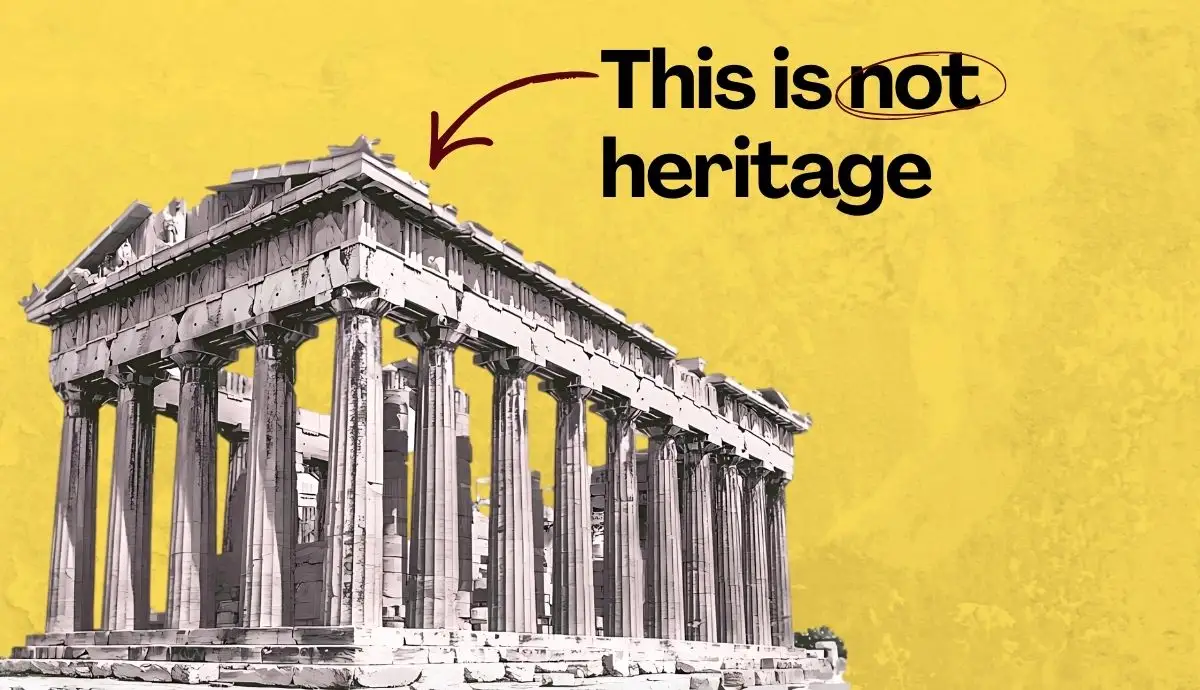
Laurajane Smith has argued that heritage is not monuments and buildings, but rather a discourse that selects what is worth preserving. She calls this the Authorized Heritage Discourse (AHD).
Key Takeaways
- Heritage as Process: Heritage is a social process of remembering that shapes our present identity.
- The AHD: The "Authorized Heritage Discourse" is an elite-driven narrative that decides what is worth-preserving based on Western, monumental values.
- Foucauldian Influence: Smith uses Foucault’s theories to show how "heritage" is actively constructed by those in power.
Who decides what is worthy of preservation? Laurajane Smith has argued that political and cultural elites shape the way we understand what heritage is by “enforcing” a certain discourse that selectively judges what is worth-preserving and what is not. This power dynamic is central to what Smith identifies as the Authorized Heritage Discourse (AHD).
Laurajane Smith’s Understanding of Heritage
Laurajane Smith is a Heritage and Museum Studies scholar at the Australian National University. Particularly influential among Smith's publications is her edited volume titled Uses of Heritage (2006), where she examined the politics of heritage and what she termed “Authorized Heritage Discourse”.
In this work, Smith argued that (Cultural) Heritage is not the material monuments with which we usually associate it.
“… heritage not so much as a ‘thing’, but as a cultural and social process, which engages with acts of remembering that work to create ways to understand and engage with the present” Smith 2006, 2
Instead, Heritage is a discourse created by and enforced from the elites to control the narrative around what deserves to be preserved and what not.
What is to be praised as high art and cut off from its original context and community and what should be devalued and treated as lowly art. Smith termed this discourse “Authorized Heritage Discourse”.
“… heritage is used to construct, reconstruct and negotiate a range of identities and social and cultural values and meanings in the present. Heritage is a multilayered performance – be this a performance of visiting, managing, interpretation or conservation – that embodies acts of remembrance and commemoration while negotiating and constructing a sense of place, belonging and understanding in the present.” Smith 2006, 3
Effectively the AHD is shaping collective memory by dictating what makes it into the mnemonic canon (what is to be remembered, preserved, exhibited).
The Idea of Discourse
Smith is using the term “discourse” in the way first presented by the French philosopher Michel Foucault. Foucault’s discourse is a system of representation that shapes how we understand and talk about topics, ultimately creating the objects of our knowledge.
For Foucault, discourses are practices that systematically form the objects of which they speak.
Smith applies this Foucaultian understanding to heritage, arguing that the Authorized Heritage Discourse doesn't simply describe pre-existing heritage objects but actively constructs what counts as heritage. Through this discourse, certain narratives, values, and material objects are privileged while others are marginalized or rendered invisible.
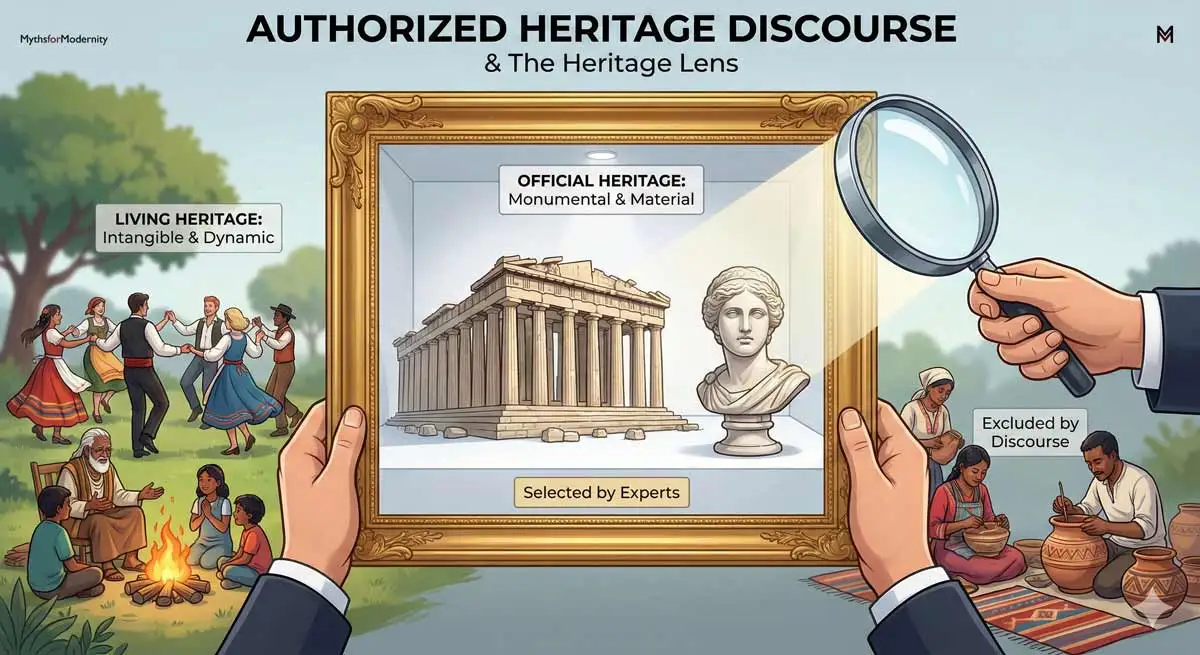
As with Foucault’s political discourse, the power of AHD lies in its ability to appear natural and self-evident as well as its ability to naturalize certain ideas about what constitutes heritage. Through this process, AHD works to legitimize the power of the elite and maintain the established hierarchy.
Smith believes that AHD’s origins stretch back to nineteenth-century Western values and cultural concerns. However, AHD is not only found in the so-called West but “in the authorial voices of the upper middle and ruling classes of European educated professionals and elites” (Smith 2006, 28).
The Characteristics of AHD
In Smith’s own words:
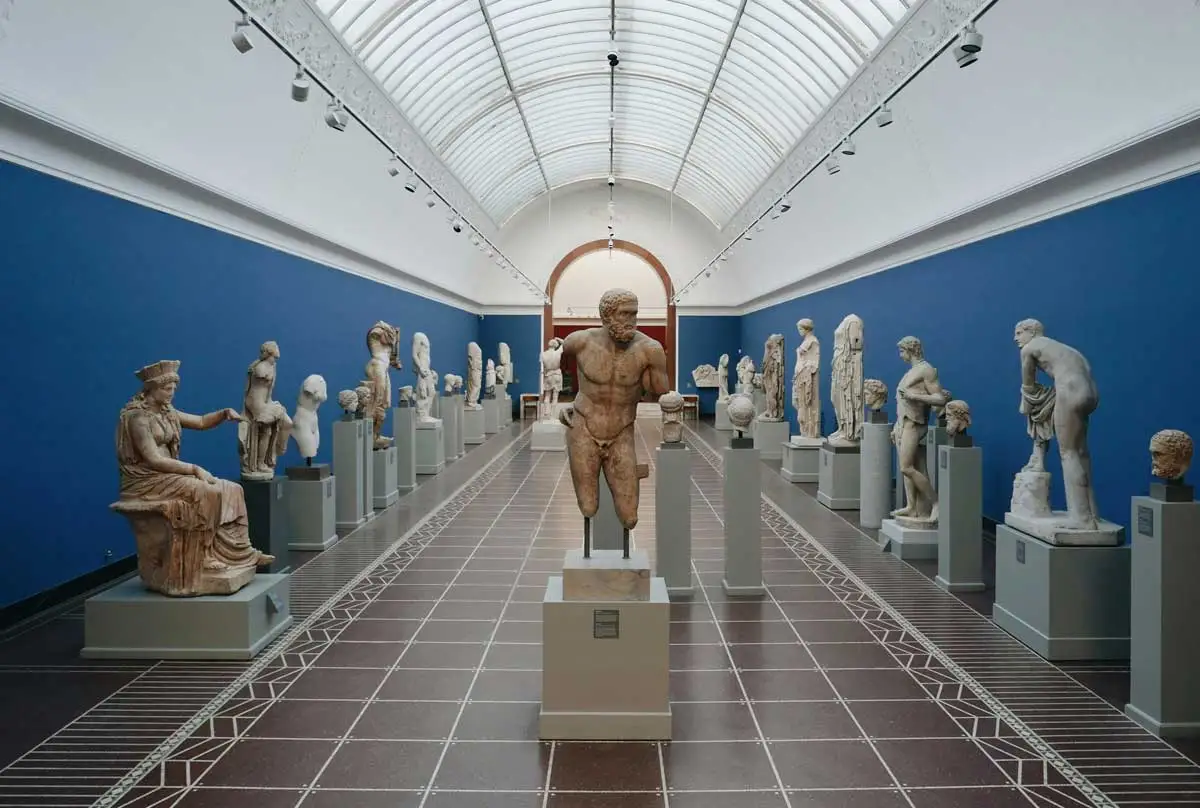
“[AHD] privileges monumentality and grand scale, innate artefact/site significance tied to time depth, scientific/aesthetic expert judgement, social consensus and nation building. It is a self-referential discourse, which has a particular set of consequences.” Smith 2006, 11
This means that as a discourse, AHD uses certain mechanisms and is looking for specific characteristics in order to describe certain things as heritage. In short:
- It emphasizes materiality and monumentality, focusing on grand structures rather than intangible cultural practices.
- It presupposes that artefacts and sites have an innate value that is connected to their antiquity, their “time depth”.
- It privileges expert knowledge and aesthetic judgments over local or indigenous values.
- It often presents heritage as static and unchanging rather than dynamic and evolving.
Through these mechanisms, AHD creates a framework that determines which aspects of the past are deemed worthy of preservation and official recognition.
AHD as Contested
Even though the AHD is the dominant discourse, it is actively challenged and contested.
Smith (2012) has discussed how Aboriginal communities and activists have questioned archaeological practices leading to policy changes and different approaches to heritage management and perception.
This means that the AHD is not always enforced or supported by the state. Still, AHD's power does not lie in its universal enforcement but its ability to contain debates within certain parameters dominated by a certain form of expert knowledge that can excludes others. This way heritage becomes centralized and manageable by the state while other forms of heritage are effectively constrained and limited.
This has two important consequences:
- For archaeologists it means that "archaeological practices that intersect with community performances of heritage will be framed by the AHD" (Smith 2012, 22), unless archaeological authority is challenged and critical discourses pushed forward.
- If the AHD is more and more challenged, archaeologists, will inevitably become engaged in ‘identity politics’. Especially in contexts where heritage becomes contested between various groups archaeologists are asked to mediate or negotiate group identities through the arrangement of heritage. This means that archaeologists need to understand how the AHD functions to properly understand the dynamics of heritage and avoid settling disputes without understanding the consequences.
The Digital Age Is Complicating Things

The 21st century has seen the dawn of a digital age. As museums are digitizing collections and cultural organization are becoming online agents, the discourse about heritage has also moved to the digital space.
Here, it is important to understand that the field is dominated by algorithms that inadvertently enforce and perpetuate the AHD. One example is how search engine results may privilege a museum's description of an object, as the museum is seen by the algorithm as an authoritative entity, but "hide" a local, perhaps indigenous, claim to the object. In this digital space, new emergent versions of the AHD are becoming apparent.
As we bring more and more of our world online it is important to be wary of our own biases or else we risk bringing systemic injustices in a digital space and cementing them.
Bibliography
- Smith, L. (2006). Uses of Heritage. Routledge. DOI: 10.4324/9780203602263
- Smith, L. (2012). "Discourses of heritage : implications for archaeological community practice.", Nuevo Mundo Mundos Nuevos. DOI : https://doi.org/10.4000/nuevomundo.64148
Also read: