The Tragic Life of Maurice Halbwachs and the Social Frameworks of Memory
Before Maurice Halbwachs died in the Buchenwald concentration camp, he revolutionized sociology with his theory of collective memory.
Key Takeaways
- Definition: Maurice Halbwachs defined collective memory as a social process where groups construct shared identities through frameworks like family, religion, and nation.
- Tragic End: Halbwachs was deported and tragically died at the Buchenwald concentration camp in Germany in 1945.
- Influence: Deeply influenced by Émile Durkheim, his revolutionary sociological theories permanently changed how modern academics approach memory.
French sociologist Maurice Halbwachs revolutionized how we understand the past by introducing the concept of "collective memory." Before his groundbreaking work, memory was viewed strictly as an individual, psychological phenomenon. Halbwachs argued that our memories are actually socially constructed, shaped by frameworks like family, religion, and the nation.
Tragically, his life was cut short in the Buchenwald concentration camp due to his active role in the French Resistance. The development of the field of Memory Studies in the past few decades indicates that his legacy is still alive and the interest in collective memory has not faded
The tragic life of Maurice Halbwachs
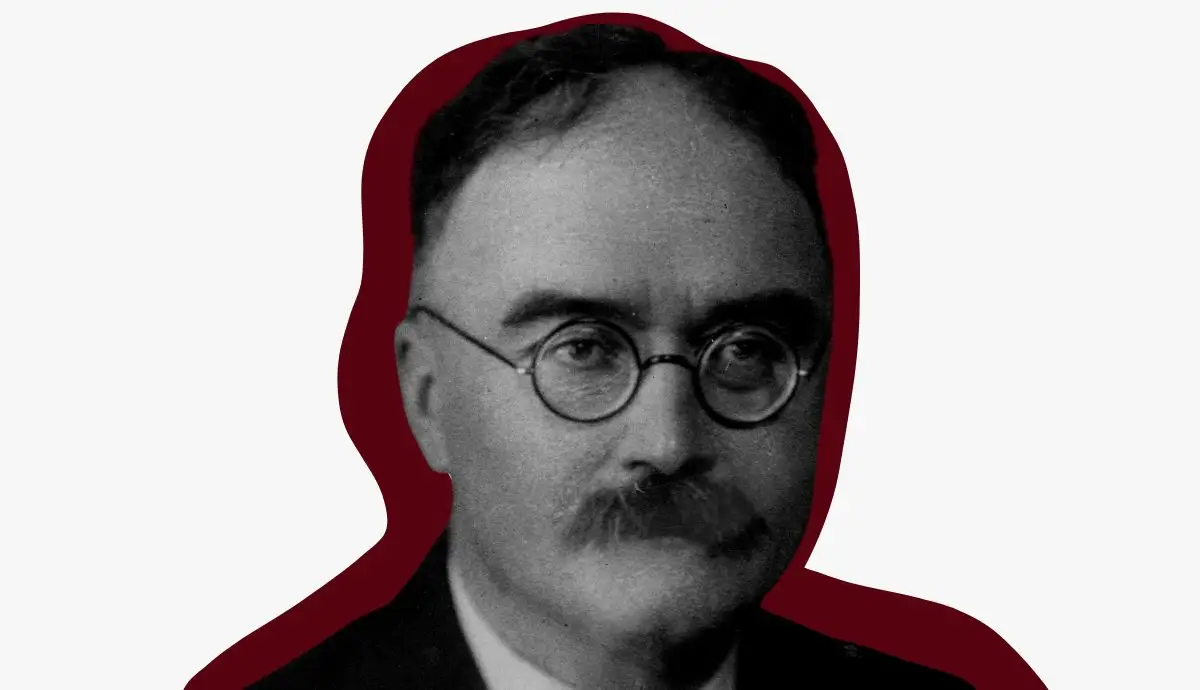
Born in Reims in 1877, Halbwachs studied philosophy under Henri Bergson and became politically active as a member of the Socialist party.
After 1904, he worked as a teacher in Hanover and Göttingen. In 1909 he gained his doctorate in law and in 1913 a second doctorate in literature. In 1935, he was awarded a chair at Sorbonne to teach social economics.
In 1938 he started taking in Jewish intellectuals fleeing from Nazi Germany and Austria. In 1940 he joined the Thermopyles intelligence network of the French Resistance.
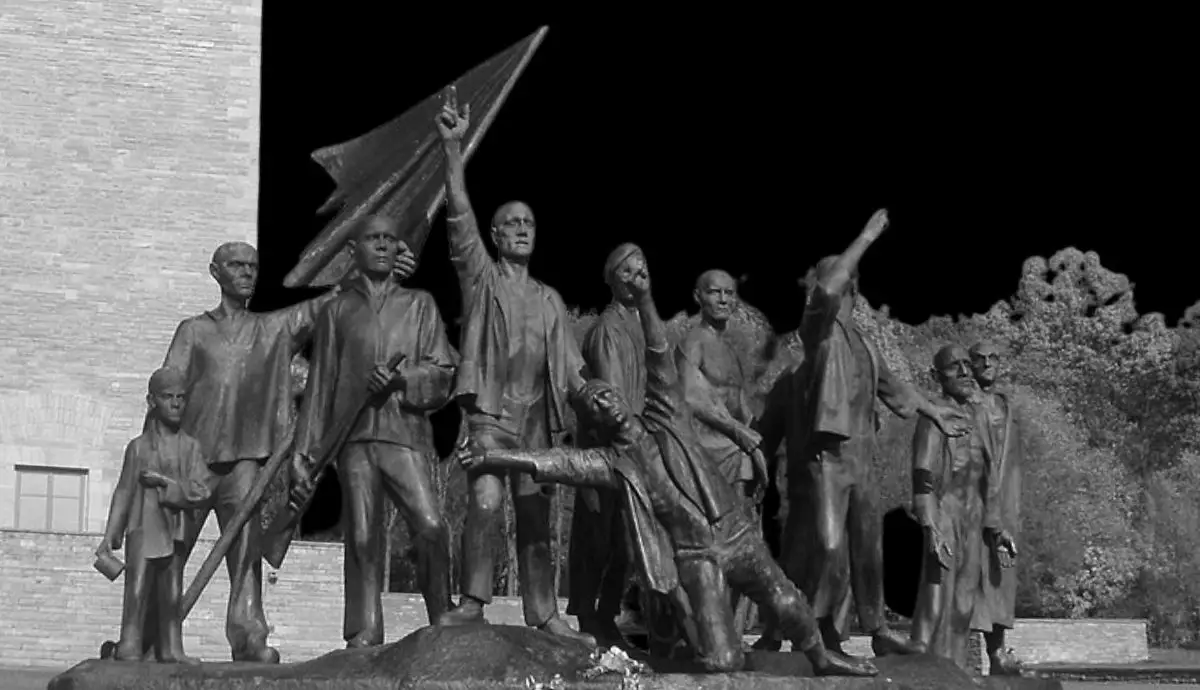
In 1944, he was elected to the Collective Psychology chair at the Collège de France but he was soon arrested by the Gestapo because of his socialist-marxist ideas and for sheltering his two sons who were active resistance members.
Halbwachs and his youngest son Pierre were deported to the Buchenwald concentration camp where he eventually passed away from an illness on March 16 1945.
| Year | Event |
| 1877 | Born in Reims, France. |
| 1904 | Begins working as a teacher in Hanover and Göttingen. |
| 1909 | Earns his first doctorate in Law. |
| 1913 | Earns his second doctorate in Literature. |
| 1925 | Publishes his groundbreaking work, Les Cadres Sociaux de la Mémoire (The Social Frameworks of Memory), establishing his theory of collective memory. |
| 1935 | warded a chair at the Sorbonne to teach social economics. |
| 1938 | Begins taking in Jewish intellectuals fleeing from Nazi Germany and Austria. |
| 1940 | Joins the Thermopyles intelligence network of the French Resistance. |
| 1944 | Elected to the Collective Psychology chair at the Collège de France. Shortly after, he is arrested by the Gestapo for his socialist-Marxist ideas and for sheltering his sons (who were active in the resistance). |
| March 16, 1945 | Passes away from illness in the Buchenwald concentration camp. |
| 1950 | A collection of his work is published posthumously as La Mémoire Collective (The Collective Memory). |
What is Collective Memory? A Social Function
Collective memory is a shared social process where groups construct identities by selecting specific past events to remember or intentionally forget.
At the time of Halbwachs, memory was treated just as an individual aspect of the human brain.
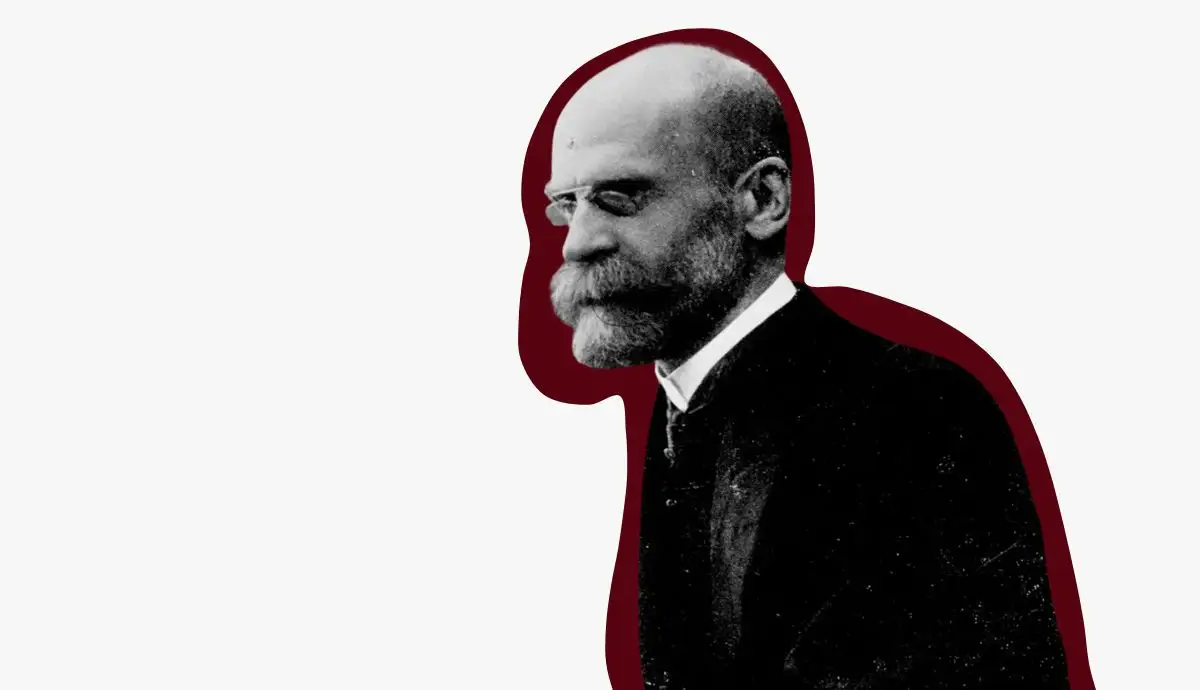
However, Halbwachs had studied under Émile Durkheim (1858-1917), a pioneer in the field of sociology. Durkheim promoted a study of social phenomena as results of greater social movements, not individual actions.
Influenced by Durkheim, Halbwachs studied memory as a social function, through a sociological, and not a biological or psychological function.
Halbwachs' collective memory was heavily influenced by Durkheim's work and more specifically his collective consciousness, i.e., the beliefs and sentiments held in common by the average member of a society.
For Halbwachs, memory is never a passive, objective playback of the past like a video recording. Instead, we reconstruct the past using the minds and needs of the present. A social group will unconsciously alter, emphasize, or completely rewrite its history to justify its current political goals, social values, or moral stances. If a memory no longer serves the group's current identity, it is filtered out.
Social Forgetting
Just as groups actively choose what to remember, Halbwachs emphasized that forgetting is also a vital social function.
A society can choose to eliminate or repress memories that cause internal conflict, shame, or threaten social cohesion. For a group to maintain a unified identity in the present, certain historical fractures must be intentionally, collectively forgotten. So, forgetting is not essentially bad, just as remembering is not inherently good or bad.
Both remembering and forgetting are dynamic processes informed by ever-changing social strctures and group identities.
The Social Frameworks of Memory (1925)
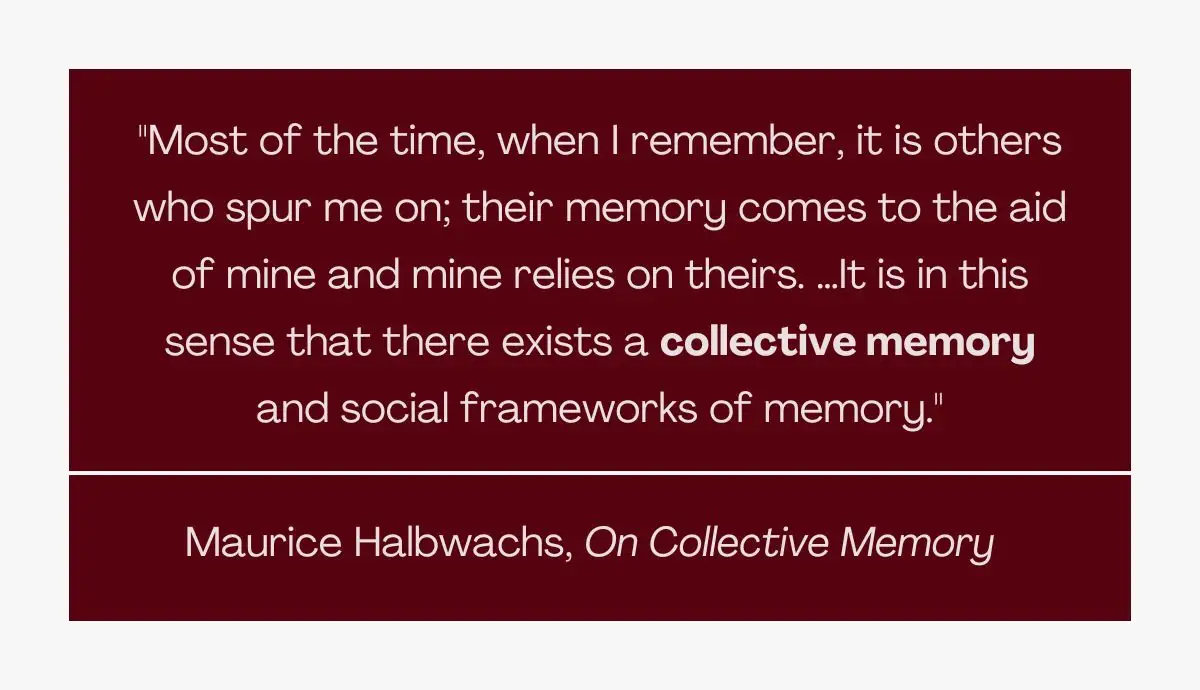
In 1925, Halbwachs first developed his theory on memory in Les Cadres Sociaux de la Mémoire (The Social Frameworks of Memory).
In this work, Halbwachs used the term cadre (framework) to define the contexts within which memory takes form. Such frameworks are the family, the religion, the nation, etc.
Collective Memory (1950)
In 1950, a collection of his work on memory was published posthumously by Halbwachs' sister under the title La Mémoire Collective (The Collective Memory). It has since become a classic refference among historian and professionals within the growing field of memory studies.
The Difference Between Collective and Individual Memory

In a beautiful segment from La Mémoire Collective, where Halbwachs describes how we mistakenly think of memory as an isolated individual experience while in reality it's socially constructed.
"In reality, we are never alone. Other men need not be physically present, since we always carry with us and in us a number of distinct persons." (Halbwachs 1980, 23)
For Halbwachs, individual memories, the way individuals remember impact one another. These individual memories interact and shape how various events are remembered
So we could say, that the collective memory is made of individual memories. However, it is equally true that collective memory, the group's established narrative, shapes what and how individuals remember.
So individual and collective memory are connected but not identical.
"The collective memory, for its part, encompasses the individual
memories while remaining distinct from them. It evolves according
to its own laws, and any individual remembrances that may penetrate
are transformed within a totality having no personal consciousness." Halbwachs 1980, 51
In even simpler terms, you, an individual, belong to multiple groups sharing: your family, your neighborhood, your school, your university, your work, your country, etc. Your participation in these groups, shapes your identity, but since you are also part of the group , you also slightly influence it.
Collective memory is like a mosaic, change enough pieces and you have a different image.
History vs. Collective Memory: Halbwachs' Distinction
Halbwachs distinguishes between history and collective memory. History follows the end of memory.
Collective memory is a direct, personal interaction with the past, while history is a mediated one, an interaction that comes into play only after the memory has faded. As long as the memory is alive, there is no reason to study it as history.
For Halbwachs, memory is alive, changing, and negotiable, while history distant and rigid.
An example of collective memory in action
How do large groups actually sustain these memories? Sociologist Paul Connerton (1989) built upon Halbwachs' foundation by pointing to commemorative ceremonies.
Take the French national holiday, Bastille Day. An individual born in 2000 has no biological memory of the 1789 revolution. Yet, through the "social framework" of annual parades, national anthems, and fireworks, the French state actively constructs and transfers this memory to the individual.
The holiday acts as a mechanism, ensuring that the collective memory of the Republic survives long after the original participants have passed into history.
Bibliography
- Connerton, P. 1989. How Societies Remember. Cambridge University Press.
- Halbwachs, Maurice. 1980. Collective Memory. translated by Francis Ditter and Vida Yazdi Ditter.
- Olick Jeffrey and Joyce Robbins. 1998. ‘Social Memory Studies: From 'Collective Memory' to the Historical Sociology of Mnemonic Practices’. Annual Review of Sociology 24: 105–40.
Accessible online biographies:
- Collège de France. https://www.college-de-france.fr/en/chair/maurice-halbwachs-group-psychology-statutory-chair/biography
- Bauhaus-Universität Weimar. https://www.uni-weimar.de/en/university/profile/portrait/maurice-halbwachs-auditorium/biographical/
- Buchenwald Memorial. https://www.buchenwald.de/en/geschichte/biografien/ltg-ausstellung/maurice-halbwachs