Museums as Heterotopias: Foucault, Bennett, and Disciplinary Power
First Michel Foucault and then Tony Bennett analyzed museums as special kinds of heterotopias that "accumulate time".
Key Takeaways
- Heterotopias of Time: Michel Foucault classified museums as modern Western heterotopias built to perpetually accumulate all epochs, forms, and tastes in a single space.
- Disciplinary: Tony Bennett demonstrated how 19th-century public museums emerged as civilizing tools to cultivate well-behaving citizens.
Biopolitics is a term that was popularized by Michel Foucault in the 1970s to denote the form of politics that seeks to control and regulate life. When we think of biopolitics we usually think of fields such as medicine or even economics. But we rarely think of heritage or museums in particular.
In The Birth of the Museum (1995) Tony Bennett embarked on a Foucaultian analysis of the institution of the museum. Bennett looked into the history of the institution tracing its course through time and the ideologies that led to its birth and rise.
Bennett investigated 19th and 20th-century museums in N. America, Australia, and Britain, showing how they functioned as disciplinary instruments of public instruction.
Key in Bennett's approach is the term of the heterotopia that Foucault first used to describe museums, among many other things.
Heterotopias and Heterochronies
In his essay Of Other Spaces, Michel Foucault wrote that the museum is a western form of heterotopia that accumulates time.
"the idea of accumulating everything, of establishing a sort of general
archive, the will to enclose in one place all times, all epochs, all forms,
all tastes, the idea of constituting a place of all times that is itself outside of time and inaccessible to its ravages, the project of organising in this a sort of perpetual and indefinite accumulation of time in an immobile place, this whole idea belongs to our modernity." (Foucault 1986, 26)
Foucault specifically termed these temporal spaces heterochronies (hétérochronies), i.e., spaces that open up when individuals find themselves in a complete break with traditional, linear time.
In his fourth principle of heterotopia, Foucault identified two opposite heterochronies: on the one hand, heterotopias linked to time in its most precarious form (e.g. fairs and festivals), and on the other, heterotopias of indefinite accumulation, where time is captured and preserved forever (e.g. museums and libraries).
Here we will focus on the second form, and more specifically on the example of the museum.
The Museum as a Heterotopia
To establish such a strange place, i.e., the museum as a space that seeks to collect and exhibit as much of the universe as possible, a specific ideological context was required.
For the museum to "accumulate time" it had to first locate itself as a space outside of time, a space of pure rationality that could impose order on chaos.
The development of science and rationalism certainly played a part here. It was only as a scientific institution that the museum could become a separate entity from its predecessors, like the cabinet of curiosities, which was virtually chaotic, unscientific, and disorderly.
Specialization and classification were also important. A natural history museum focused on a different thing than an art museum (specialization). Also within the museum, the objects were organized into groups and subgroups, and arranged accordingly (classification).
The cabinet of curiosities for example was driven by a desire to surprise and create wonder. Often a cabinet could consist of unrelated objects and even unscientific ones (like unicorn horns or mermaid tails).
The museum as a "civilizing" tool
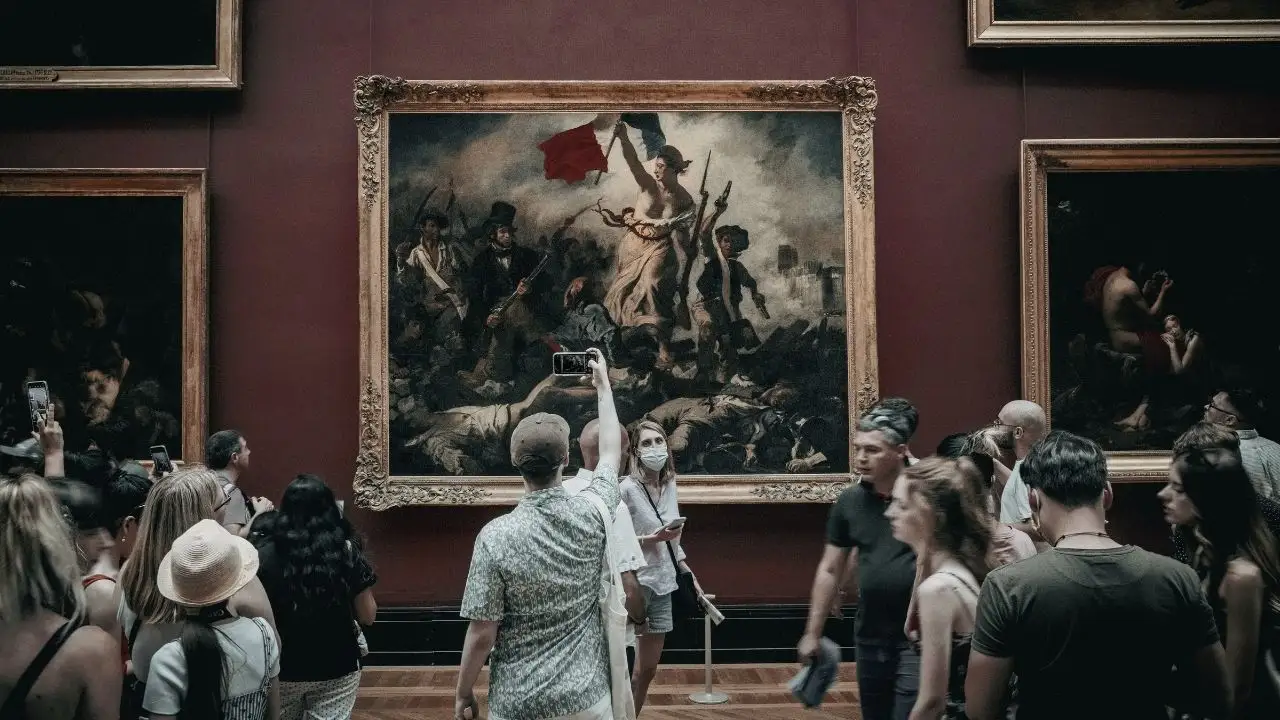
In the 19th century, museums, as well as libraries, were seen as important for the mental health of a city's residents, just as a hospital and a park were for the physical.
Additionally, museums, as bearers of high culture, were established as a "civilizing force" with disciplinary function. A museum, alongside spaces like the theatre, the library, the art gallery, and others, was believed to be able to cultivate lawful and obedient citizens.
The idea was that museums exhibited high culture. Being exposed to high culture was seen as sort of a remedy able to reshape the individual and imbue them with restraint that could tame rebellious desires and other unworthy pursuits (such as drinking and gambling).
Museums evolved out of this elitist ideology.
The Exhibitionary Complex vs. The Panopticon
The interesting thing with a heterotopia is that it both reflects and contrasts the world surrounding it. Through this process, it points toward a new path by inverting reality and upsetting the established order from within.
In the case of the museum, it is not hard to see how a museum reflects and contradicts its sociocultural context.
A museum exhibits artifacts, and through the very act of exhibiting them, it takes them outside of their original context. The objects now stand timeless in a new space. This is known as musealization.
This facilitates radically new interpretations and approaches but at the same time the discussion remains confined within the museum whose very form is designed to narrow discussions to what is socially acceptable. Think of how we are supposed to act in a museum, how we are supposed to walk and approach exhibits. There is a very distinct division between the exhibit and the visitor, and another one between these two and the expert who has privileged access to spaces and objects within the building.
This is where Tony Bennett makes his most significant theoretical addition to Foucault through what he termed the "exhibitionary complex."
In Discipline and Punish, Foucault famously focused on the Panopticon, an architectural apparatus of surveillance, where the state could effectively monitor or create the sense that everyone is being monitored to discipline individuals.
Bennett argued that 19th-century public museums, world fairs, and art galleries did the exact opposite: they were technologies of open spectacle. In the museum, the modern state displayed power and knowledge. Visitors were invited to inspect the exhibits, but more importantly they inspected each other.
By observing how their peers dressed, spoke, and moved through the galleries, working-class visitors learned to self-monitor and internalize codes of politeness and lawfulness without requiring physical coercion.
The Museum as Biopolitical Tool
This brings us full circle back to the question of biopolitics. If biopolitics represents the modern state's management of the social body, the public museum was one of its most sophisticated instruments.
The state deployed the museum to "civilize", essentially to discipline. Just like the exhibits, the visitors are themselves classified into civilized and brutes, into low and high class, into those deserving of the state's protection and attention and those not.
In many modern states (like Greece, Israel, Italy, etc), museums were used to construct a national identity, promoting a certain form of Greekness (in the case of Greece) as correct and another as wrong. Ancient Greece was promoted as the nation's foundation helping to fashion a new national body or imagined community as Anderson puts it based on a common foundation. However, this foundation could easily be used to exclude others; those who did not fit into the description of the new standard, but that is another discussion for another time.
Bibliography
- Anderson, B. (1983). Imagined Communities: Reflections on the Origin and Spread of Nationalism. Verso.
- Bennett, T. (1995). The Birth of the Museum: History, Theory, Politics. Routledge.
- Foucault, M. (1986). Of Other Spaces. Diacritics, 16(1), 22–27.