The Necropolitics of Kafka's Penal Colony
An exploration of Franz Kafka's "In the Penal Colony" through the lens of biopolitics, Agamben's bare life, and Mbembe's necropolitics.
Key Takeaways
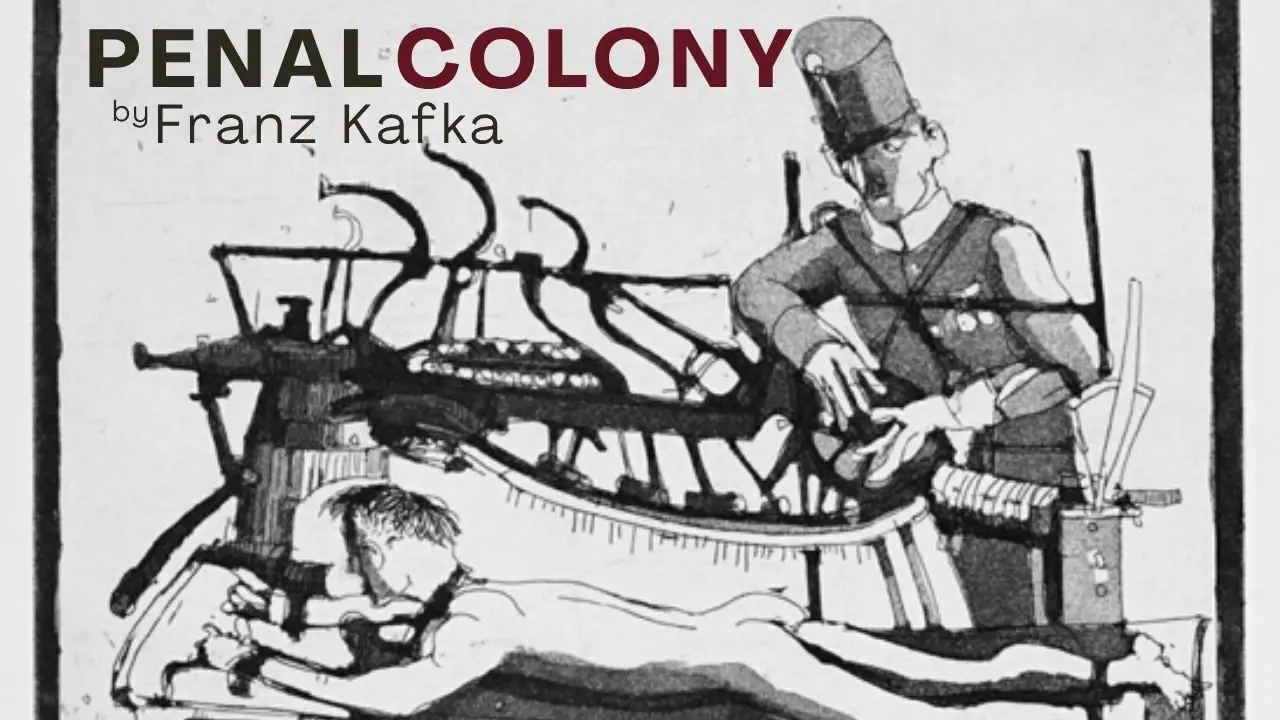
- Kafka's machine (apparatus) embodies modern state power exerted through total control over disposable human bodies.
- The liberal new order conceals state violence out of sight but does not abolish it.
- Through Agamben and Mbembe, Kafka's machine mirrors contemporary digital surveillance and systemic necropolitics.
"The explorer wanted to do something, if possible, to bring the whole machine to a standstill, for this was no exquisite torture, such as the officer desired; this was plain murder."
The line above marks the turning point in Franz Kafka's 1919 novella, In the Penal Colony. The narrative follows an unnamed, presumably Western explorer visiting an isolated penal settlement. There, an officer proudly demonstrates "the apparatus", a bizarre, intricate machine that tortures and executes condemned prisoners with mechanical precision.
In this article, I will try to explain what Kafka was actually talking about and connect it to two previous articles about necropolitics and bare life
In the Penal Colony by Franz Kafka
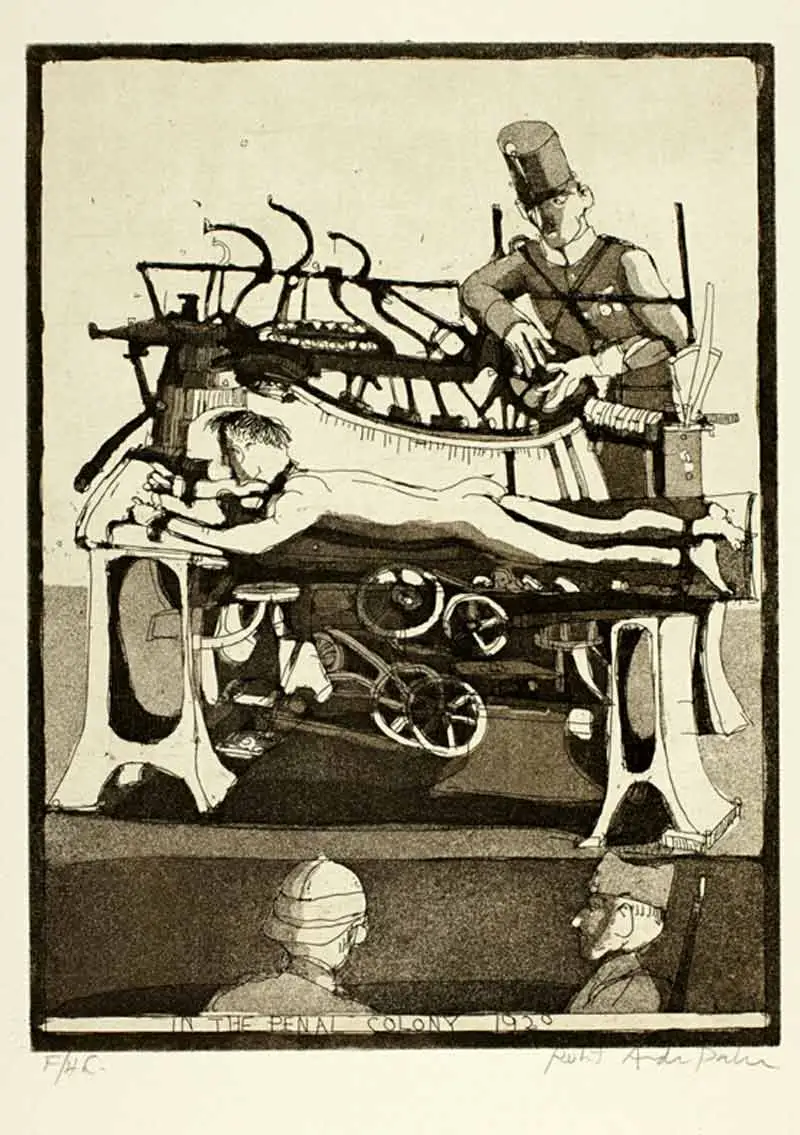
The officer is enthusiastic about the machine's capabilities, which he wants to demonstrate using a soldier who has been condemned without his knowledge. As time passes, we learn more about the machine's parts and functions. We learn that it consists of three parts:
- the lower one called the Bed
- the upper one called the Designer
- the Harrow, a middle part that "moves up and down"
The officer cannot hide his admiration for the machine, which is designed to work without pause for 12 hours straight, inscribing the broken law onto the individual's body.
During the first six hours, the machine works slowly; the punished man is subjected to deepening pain as the needles inscribe his punishment deeper and deeper into his body. The final six hours are when the wounds get so deep that the subject goes silent and seems to experience a sort of epiphany:
"But how quiet he grows at just about the sixth hour! Enlightenment comes to the most dull-witted. It begins around the eyes. From there it radiates. A moment that might tempt one to get under the Harrow oneself."
At the end, the body is completely pierced through and unrecognizable. A truly haunting scene.
Justice in the Penal Colony
It is interesting that in Kafka's story, there is no judicial process. The accused does not even know the charges against him, or even the fact that he has been condemned, until he is led to the machine.
Even as he is strapped to the machine, he still does not know why he is being punished. He learns the reason during the torture as the broken law is inscribed on his body and "our man deciphers it [the script] with his wounds".
The story takes an unexpected turn when the officer becomes frustrated that the explorer is not keen to help him save the machine from the colony's new Commandant, who disapproves of the machine and wants to terminate it. The officer, understanding that the future of the machine is at stake, straps himself to the machine.
However, he doesn't get to experience this epiphany.
The machine malfunctions and the explorer witnesses the brutal death of the officer who, within minutes, is smashed by the spikes that were supposed to inscribe him with the phrase "be just".
The explorer does not take action until it becomes evident that the machine is killing the officer faster than anticipated and proclaims in a quasi-comic tone that this is no longer torture "but plain murder."
The novel does not end here. The explorer finds the previous commandant's gravestone, which bears a prophecy that one day he and his followers will return to take over the colony once again (and presumably reinstate the machine to its former glory). The traveller abandons the colony as the story reaches its end.
What is the story about?
Kafka's novel is one of his most mysterious with numerous interpretations. I will not present them all but I will instead focus on the one that I found most interesting.
As readers, we experience the banal absurdity of the machine's cult and its followers through the eyes of the explorer. The explorer is presented as an educated, enlightened individual. He views the mystical relationship that the officer has developed with the machine. He does not agree with the absurd injustice of executing someone without trial and also does not approve of the brutal method by which the execution is performed.
In the story, we understand that the new commandant is also of the same mindset as the explorer. Both of them represent a new class of humanist citizens who are replacing an older class of colonialists.
Even though the new class disagrees with the practices of the old class, they do almost nothing to stop the injustices. The new commandant is not stopping the public executions. He is only making them more difficult by making it hard for the machine to be preserved and repaired.
The explorer also does not stop the killing that is about to take place before his eyes. He says nothing when the officer straps a random soldier to the machine, and does nothing to stop the officer from stepping into the soldier's place.
Perhaps the story is about our indifference when confronted with brutality in real life. But I also think that Kafka is brilliantly painting two overlapping worlds on his canvas.
The Two Worlds
The first is the world of the colony, a world of bare brutality, where might makes right, where justice is defined by those holding the power, and where control over the human body is absolute.
In this world, the human body is disposable, always ready to be thrown to the colonial machine, with its innumerable cogs and chains that work tirelessly to break the body down, to dissect it, until nothing remains.
This world is succeeded by another one. This second world reluctantly tolerates the colonial practices with distaste. This new world is not one without brutality. The machine is still there. It's just that people no longer want to see it. The crowds attending the public execution, says the officer, used to be huge back when the previous commandant ruled over the colony. Now, no one is interested.
Brutality is concealed. People don't want to see it but don't care enough to stop it. The most they are willing to do is tolerate it and make it more difficult for the machine to perform its work. But the machine is still there and the shadow of the old commandant seems to be haunting the island with the apocalyptic vision of his return.
In a sense, the machine is the embodiment of colonial technology; a technology that now turns in on itself. In 1950, Aimé Césaire published his essay Discourse on Colonialism where he argued that the colonial practices used to discipline and control colonial subjects will eventually be deployed domestically against the very citizens of the colonizer.
The Politics of Life in the Colony
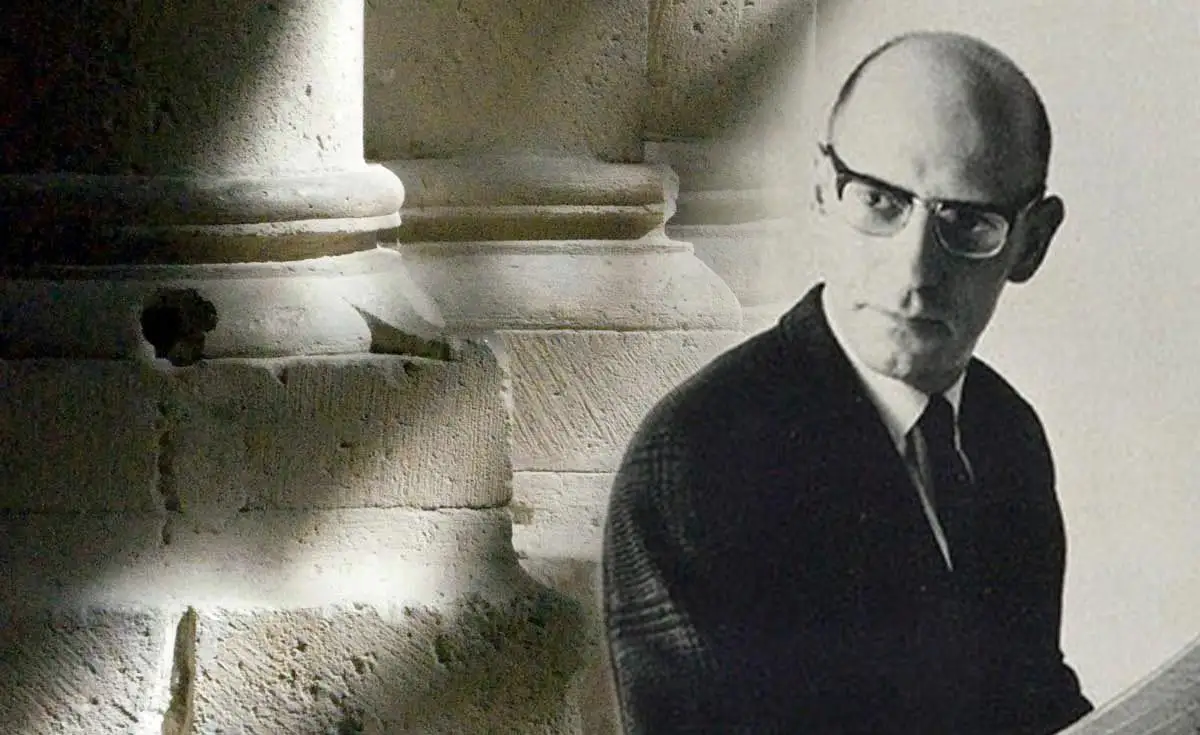
In the 70s, Michel Foucault described a new form of sovereign power, biopower, which developed during the 18th century as "the State control of the biological" (Foucault 2003, 240). As a form of politics concerned with the management and control of life, biopower is an effective way that the modern state employs in a society that is constantly under surveillance (in the digital age this is more true than ever).
In Homo Sacer, Agamben supplemented Foucault. The modern state is sovereign because it can decide whom to exclude from the protection of its laws at will (the so-called state of exception). The state can kill or make it hard to live for anyone deemed unworthy of protection. Whoever is labeled an enemy of the state is fair game for unfair treatment.
Necropolitics
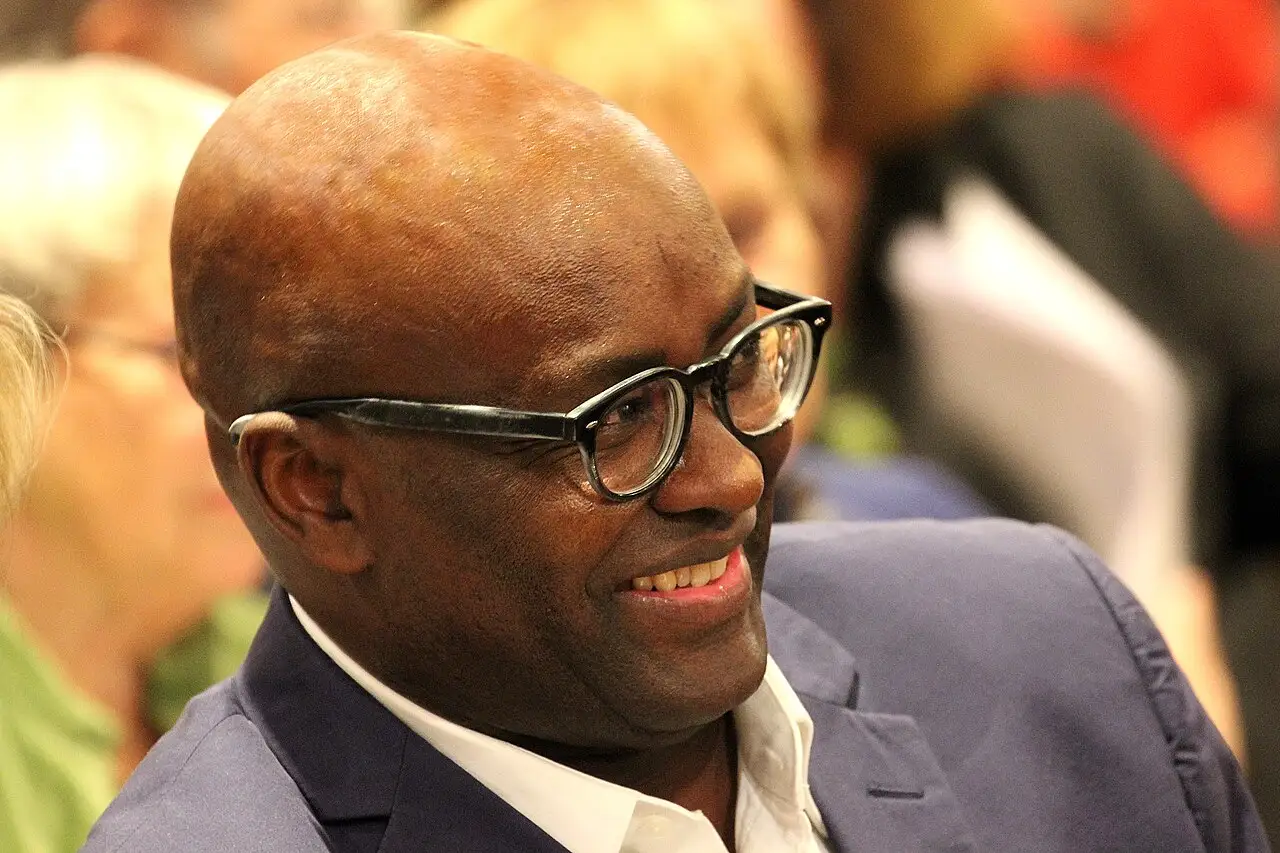
Picking up the thread from Foucault and Césaire, Achille Mbembe wrote in 2003 about necropolitics; i.e., the power of the state to create deathworlds, spaces where human beings are treated as dead or almost dead. The culmination of the deathworld was the concentration camp of WWII.
Deathworlds can be traced as far back as the colonies of past centuries, where the colonist and the colonized existed in two different worlds, one next to the other. The colonist was justified in abusing the colonized, who was excluded from the law, stripped of all civic protections (what Agamben described as bios) and reduced to bare life (what Agamben described as zoe), whose termination was justified and even expected.
Mbembe argues that deathworlds are increasingly being integrated into every aspect of society thanks to evolving digital technologies and mass surveillance. A great example of this according to Mbembe is Apartheid South Africa, the United States during segregation, and Israel. The idea is that one does not need to be confined within a physical camp to reside in a deathworld.
At the Mechanical Hands of the Machine
The deathworlds now mingle with civic law and the fear that anyone can at any time and without warning be strapped to Kafka's machine is ever-present. Just like Kafka's machine, modern deathworlds are not instant executions. They are not the guillotine. They are slow, methodical processes that take their time and can last a lifetime.
By the end of the process, as soon as someone realizes that they are in fact the ones being tortured by the machine, they will lose all hope, and at that point may reach a state of epiphany, free from all worries, as the entirety of life and hope has been taken away. No future remains so there is the capacity to look beyond and above.
But perhaps Kafka is telling us something else: the epiphany offered by the machine may simply be the romantic fantasy of the oppressor. Once the officer attempts to experience the enlightenment promised by his own methods, he discovers that reality is brutal and no redemption is offered. The machine is not a god; it does not offer salvation, it does not deliver justice, and it does not lead to an epiphany. It just tortures and kills.
In a novel titled Island looking at things from another position, Aldous Huxley spoke about the alienation of the modern human. This brutal world in which we live is a source of misery and endless agony that inevitably births beautiful art. In a world of peace, harmony, and justice, such beautiful, such powerful and evocative art would not be possible.
Other interpretations
There are multiple other interpretations. Some reveal a more personal message that connects the machine with Kafka's agonizing life as a writer or the relationship of humanity and technology, which is an especially potent interpretation in this day and age where machines are adored and deified as they take a more and more active role in managing our lives.
Bibliography
- Kafka, F. (1919). In the Penal Colony. There is a free online translation available. You can find numerous interpretations online as well, but I highly recommend finding a copy with introductory comments and notes.
- Agamben, G. (1998). Homo Sacer: Sovereign Power and Bare Life. Translated by Daniel Heller-Roazen.
- Césaire, A. (1950). Discourse on Colonialism.
- Foucault, M. (2003). “Society must be defended”: Lectures at the Collège de France, 1975–1976 (M. Bertani & A. Fontana, Eds.; D. Macey, Trans.). Picador. (Original work published 1997)
- Huxley. A. (1962). Island.
- Kos, Ž. (2025). Biopolitics. In: Encyclopedia of Diversity. Springer, Cham. https://doi.org/10.1007/978-3-030-95454-3_48-1
- Mbembe, A. (2003). Necropolitics (L. Meintjes, Trans.). Public Culture, 15(1), 11–40. https://doi.org/10.1215/08992363-15-1-11