How Big Tech Shapes the Way You Think About Heritage
The Algorithmically Authorized Heritage Discourse (AAHD) explains how Big Tech algorithms transform cultural heritage into depoliticized digital commodities for individual consumption.

Key Takeaways
- The Algorithmically Authorized Heritage Discourse (AAHD) explains how Big Tech controls and shapes digital cultural heritage.
- The AAHD uses algorithms and user data to commodify heritage for digital consumption.
- Initiatives like Google Arts & Culture depoliticize heritage, turning it into aestheticized entertainment that discourages critical democratic engagement.
Heritage is more than material monuments. According to Laurajane Smith's Uses of Heritage (2006), heritage is a social and cultural process that shapes how we remember the past. This process is known in heritage studies as the Authorized Heritage Discourse (AHD) but recently, thanks to the rapid technological advancements, a new strain of AHD has become apparent, the Algorithmically Authorized Heritage Discourse (AAHD), a term coined by Inge Beekmans.
This is what happens when algorithms and Big Tech dictate not only how we perceive heritage but also how we should think about monuments.
What's the Algorithmically Authorized Heritage Discourse (AAHD)?

The Algorithmically Authorized Heritage Discourse (AAHD) is an emerging variant of the Authorized Heritage Discourse (AHD) that takes into account the ways Big Tech corporations are increasingly seeking to control and shape heritage similarly to nation-states.
The AAHD transforms heritage into networked fragments of consumer culture, producing a uniform, globalized culture where heritage is perceived as a ‘universal’ commodity stripped of its social apparatus and turned into entertainment for modern individuals.
Even though it presents itself as apolitical, the AAHD is deeply political, as it minimizes critical engagements with collective memory, heritage and Big Tech.
The idea behind the AAHD is that Big Tech is increasingly acting not simply as a peer of the nation-state but as sort of a nation-state of its own. Within this framework, Big Tech utilizes policies that are reminiscent of the nation-building policies of the previous centuries as described by Benedict Anderson.
The result is a homogenized understanding of heritage that strips it of its potential to bring change (I have also explored similar issues in a previous article about museums and the ethics of optimizing for search engines).
The term Algorithmically Authorized Heritage Discourse belongs to Inge Beekmans a Ph.D. candidate at the Tilburg School of Humanities and Digital Sciences in the Department of Culture Studies at Tilburg University, in the Netherlands.
In the following sections, we will explore what the AAHD is about.
Big Tech as a Nation-State

In an article from 2026, Inge Beekmans (Ph.D. candidate of Culture Studies at Tilburg University) observes how Big Tech corporations are regulating heritage in the digital space and builds an argument in three core points:
- Major tech corporations increasingly act as the ‘peers’ of nation-states, as they rule their digital ‘fiefs’ through policies and codes. Large corporations put forward grandiose goals that mirror election manifestos that often resemble the nation-building practices described by Benedict Anderson in the 1990s.
- Nation-states have used heritage as one of their nation-building policies. Big Tech corporations are strongly entering the heritage field through various initiatives like Google Arts & Culture, that seek to regulate culture in a manner reminiscent of 19th century nation-states.
- The Critical Heritage Studies movement interprets any use of heritage as inherently political. So, the movement needs to focus on the digital field to understand how culture and heritage are being used and appropriated.
Based on these three points, Beekmans argues that there is an emerging variant of the Authorized Heritage Discourse (AHD) that Laura Jane Smith put forward in the early 2000s which Beekmans terms the Algorithmically Authorized Heritage Discourse (AAHD).
What's new about the Algorithmically Authorized Heritage Discourse?
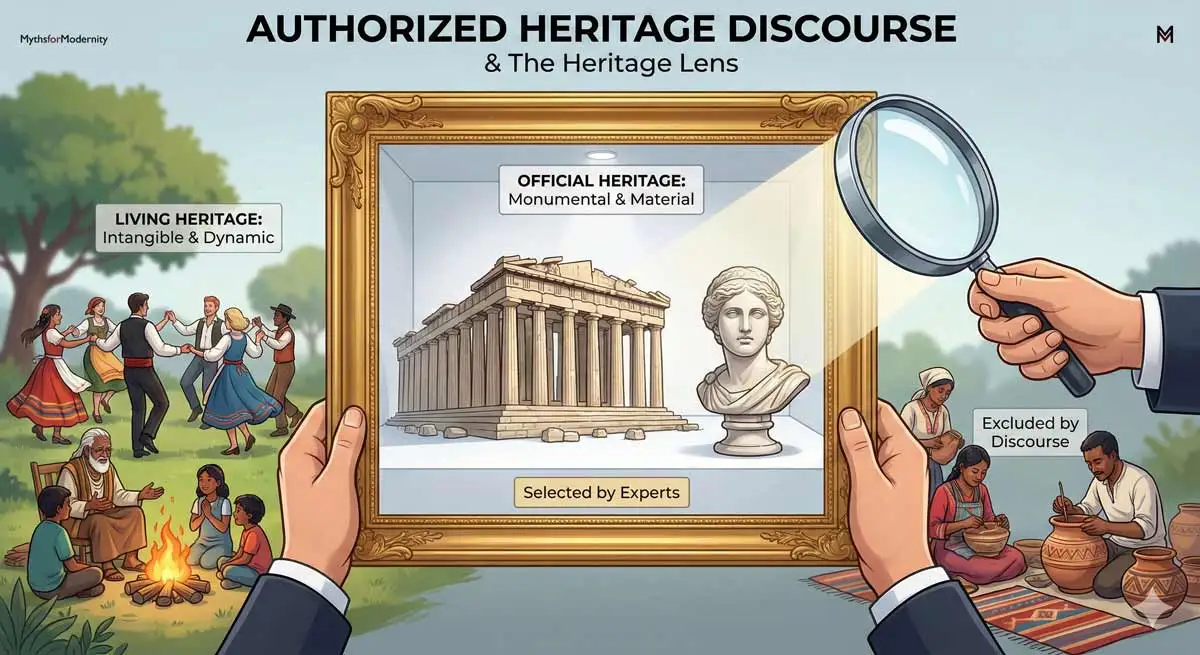
The AAHD is a variant of the AHD that is being actively constructed and enforced in the digital realm primarily by Google's algorithm.
Just like the AHD, the AAHD sides with elites and praises the grandeur, the splendour and the uniqueness of certain "masterpieces".
However, while the AHD is driven by a body of experts, the AAHD is driven (partially) by "commercial interests and the ensuing (imagined) searches, visits, clicks and scrolls of internet users" (Beekmans 2026, 71).
The result is a heritage that is there to be consumed by a public trained in the individualist environment of the Big Tech digital world.
Another difference is that the AHD focuses its efforts on selecting and constructing heritage to produce a shared narrative privileging expert voices over others. In contrast, the AAHD seeks to record "everything" into its databases and infrastructures.
In this context, heritage is no longer employed for the construction of "grand national narratives" but instead to assemble a "grand network" of data that facilitates the consolidation of power in the hands of major tech corporations.
The case of Google Arts & Culture

Beekmans examines the case of the Google Arts & Culture (GAC), which was initially launched as Google Art Project in 2011.
GAC is a non-commercial initiative by Google that partners with cultural institutions and artists around the world to preserve and bring the world’s art and culture online so it’s accessible to anyone, anywhere.
However, according to heritage experts (Beekmans 2026; Grincheva and Stainforth 2024, 52; Cao 2024) Google is not just seeking to democratize heritage but to create a digital monopoly and increase the amount of data that Google can draw from as museums and cultural institutions agree to digitize objects of all sorts.
At the project's core lies the principle of disneyfication. GAC presents heritage in a digital environment that is fun to interact with, promoting idealized descriptions of objects and eliminating all difficult issues associated with them.
"The ‘aestheticization’ of even the darkest of heritage partially matching the material ‘touristification’ of dark heritage also aligns with GAC’s efforts to avoid and de-emphasise conflict with the aim of producing a complex web of networked pages that are both practically and ideologically accessible and engaging for as many internet users as possible. (Beekmans 2026, 78)
The foundation of AAHD is the commercial interest of Big Tech corporations. The AAHD organizes heritage based on metrics such as searches, visits, clicks, scrolls, and users to establish a grand network of heritage items that are meant for individual digital consumption. The individual here is not a social subject, but an isolated one that is perceived as part of a greater universal community of users. This digital community is not a place where great narratives and social sentiments can thrive but rather a collection of individuals that is meant to consume and be entertained.
In the case of GAC,
"people are directed to focus on the present and on themselves. The AAHD nurtures cultural consumers that are not distracted by the ‘full picture’, consequently oppressing the production of shared narratives that would support the production of novel political pursuits and democratic engagement." (Beekmans 2026, 87)
Conclusion
We are living in a digital era, where the way we interact with the world is rapidly changing. Algorithms are the often unseen agents that dictate how this interaction takes place even in things as seemingly innocent as heritage. The commercialization of the digital space and the fragmentation of the social network is accelerated to facilitate the commercial interests of Big Tech elites.
In the grand networks of the tech elite, grand narratives that would help people to imagine any collective, democratic shaping of online-offline society become increasingly difficult to discern. (Beekmans 2026, 88)
As I don't want to end an article on such a pessimistic note, I think that the first step toward a less oppressive future is understanding what is wrong with the present. Big Tech corporations appear to have the initiative right now, with centralized hierarchies being enforced across the digital space. But as the digital world becomes more and more asphyxiating, the motives and goals that once remained well-hidden become more and more apparent and prone to scrutiny.
Bibliography
- Beekmans, I. 2026. The Algorithmically Authorised Heritage Discourse: how Big Tech ‘uses of heritage’ help to build Big Tech power. International Journal of Heritage Studies, 32(1), 69–90. https://doi.org/10.1080/13527258.2025.2579249
- Cao, T. L. 2024. “Platforming Digital Cultural Heritage: History, Curation and Platform Governance on Google Arts & Culture.” PhD diss, The University of Texas at Austin.
- Grincheva, N., and E. Stainforth. 2024. Geopolitics of Digital Heritage. Cambridge, United Kingdom: Cambridge University Press.
- Smith, L. 2006. Uses of Heritage. Routledge. DOI: 10.4324/9780203602263
- Smith, L. 2012. "Discourses of heritage : implications for archaeological community practice.", Nuevo Mundo Mundos Nuevos. DOI : https://doi.org/10.4000/nuevomundo.64148
- Vaidhyanathan, S. 2012. The Googlization of Everything: (and Why We Should Worry). Oakland, CA: University of California Press.
Also read