Digital Museums and the Ethics of Optimizing for Search Engines
How semantic SEO and ethical metadata mapping facilitate the discoverability of cultural heritage within algorithmic environments while also raising signifficant ethical concerns.
Today everything is digital, and I am not only talking about social media and gaming, but the digital age is influencing the very way we shape our collective memory, and through it our own identities. So what is the role of a material-centric institution in a digital landscape? What is the role of the museum in the age of digital heritage?
If I promised an easy answer to these questions, I would be promising more than I can offer. However, as a trained museologist with experience in digital publishing, I can promise that this will be a clean and concise discussion about the role of digital presence and Search Engine Optimization (SEO) for museums.
Museum Websites Help the Sector's Mission
Before we talk SEO, let's look at how websites have helped museums fulfill their mission.
According to ICOM's 2022 definition, a museum is:
“a not-for-profit, permanent institution in the service of society that researches, collects, conserves, interprets and exhibits tangible and intangible heritage. Open to the public, accessible and inclusive, museums foster diversity and sustainability. They operate and communicate ethically, professionally and with the participation of communities, offering varied experiences for education, enjoyment, reflection and knowledge sharing.”
The key aspects here are the following:
- open to the public
- accessible
- inclusive
- foster diversity
- sustainability
Museum websites have developed into a core aspect of museums' presence in the past few years, especially since 2020 and the rapid changes brought by the COVID epidemic.
Museum websites have developed into spaces that offer simple information such as the museum's address and contact details, exhibition and event schedules, and more complex services like access to digitized collections, academic blogs, and Augmented (AR) and Virtual Reality (VR) experiences that offer virtual tours, digital guides and render collections more accessible.
All these help museums engage with new audiences and become more accessible and inclusive. Of course websites, as museums' core digital space, can also help facilitate the objectives of inclusivity and sustainability, and as we will see, SEO also has a role to play in that.
Digital Exhibitions

A lot of museums have moved toward the creation of digital exhibitions which have allowed museums to showcase objects in unique formats and approach new audiences.
According to the study by Siefkes and Pfeiffer (2025) museum exhibitions fall into the following categories, which I am quoting directly from their 2025 study:
- Classical Websites (traditional experience): These are hierarchical, text-image-based designs with limited multimedia or interactive elements. Exhibitions in this category are typically organized using menus for easy navigation and provide a more traditional, static user experience.
- Scrollytelling: These exhibitions combine linear scrolling with a narrative structure, offering a dynamic experience through animations, transitions, and parallax effects.
- Virtual Rooms: This category involves navigable, spatial simulations, often using 360-degree panoramas or digital reconstructions to create an immersive experience.
- Audio/Video Formats and Tours: These formats rely on embedded media (audio or video) for storytelling. The degree of interactivity can vary, with audio tours offering a linear experience and tutorials inviting further action, online and/or offline.
- Games and Experimental Forms: Highly interactive and often gamified, these exhibitions offer novel ways for visitors to engage with content through exploration and reflection.
Keep in mind that there is significant overlap between these categories. Still this list shows the different approaches museums have adopted to engage with their digital audience and the creativity of the sector that is actively adapting to the new reality.
Dangers of the Digital Presence and Questions of Representation
Museums are social in that they help foster social connections but also in that they reside within specific social environments. In an age when the world is "losing its mind" over new technologies' potential, museum and museum professional can hardly avoid the hype.
Websites, digital exhibitions, and the multiple digital tools that museums have been adopting promise a lot but, as professionals have warned, and to paraphrase Peter Parker, with great digital power, comes great digital responsibility. Digital presence is not the solution to all of the museums' problems and it actually bears some danger:
"While digital transformation holds promise, it can unintentionally reinforce existing inequities rather than dismantle them. Consequently, museums should exercise caution in perceiving digital solutions as an inclusivity and equity panacea." Drivas and Dramaki 2025
Good SEO can be highly beneficial for a museum's social presence, and museums are privileged in the 2026 landscape as natural bearers of the EAAT that the algorithms love. What is E-E-A-T?
- Experience
- Expertise
- Authoritativeness
- Trustworthiness
E-E-A-T is Google's way to assess a website's quality with Trust being the most important. Museums, especially the established ones, will most likely have high trust scores. This is good for their discoverability but it also presents issues.
Algorithmic Bias Enforces the Authorized Discourse
One problem is that the algorithm is not unbiased (in bibliography this is typically mentioned as algorithmic bias). Algorithmic bias more often than not works against underrepresented voices and can easily reinforce dominant narratives.
As I mentioned the algorithm presupposes that a museum is more suitable to address a subject, reinforcing the (Western) expert's voice often to the disadvantage of other communities who are left misread in a digital limbo.
In a previous blog, I wrote about the Authorized Heritage Discourse (AHD) which typically prioritizes Western-centric sources and helps promote certain cultures as high and certain works as masterpieces.
The AHD is relevant in this discussion because, as Foulcaultian discourses typically do, it presents itself as self-justifying and self-evident. The public is trained in thinking within the confines of the AHD and as such is typically searching online for famous artists and timeless masterpieces.
As the algorithm seeks to cater to this need, it promotes content that reinforces established narratives, the users interact with it thus increasing its authority in the algorithm's eyes, and the cycle continues.
To understand the consequences, imagine that a user searches for an indigenous artifact. The first results are frequently the "official" records of a 19th-century imperial institution, rather than the contemporary perspectives of the descendant community. That's because the institution has established itself as an "expert" (a central pillar of the AHD), and the algorithm loves the expert which it perceives as a source of trustworthiness and authority.
If you are interested in more about how algorithms shape the ways we think about heritage, you should consider reading this article on the Algorithmically Authorized Heritage Discourse.
Large institutions also have access to funding and experts which allow it to refine its online presence. As clean, modern, professional layouts are the algorithm's favorite, this further increases the divide as not everyone can afford a team of developers and an SEO expert. Of course SEO could help smaller museums, and other underrepresented communities strengthen their voice by enhancing their online presence but if we want to be realistic, it's difficult to imagine a grassroots movement website beating a national museum in search rankings, and that remains an unfair advantage.
Still this privilege can become an opportunity to rebalance the narrative:
- Museums can optimize their websites for local names, indigenous terminology, alongside "traditional" academic names. This creates a "Dual-Path" for discovery and raises awareness.
- Museums can make data accessible in the language of the culture of origin. Providing translated metadata and Schema (more on that in a bit) in multiple languages allows local communities to find and engage with their own heritage through search.
- Link to Indigenous scholars, local archives, and grassroots projects. This helps algorithms re-evaluate and understand the relationships between objects and their rightful contexts. It also tells LLM's and search engines that these sources are trusted by the museum and helps them gain visibility.
- Create discursive spaces online. I am not saying build open fora but invite discussions with communities over difficult issues and showcase it online with transparency. Obviously this is the most difficult and sensitive item in this list, and there are a lot of things to take into account when dealing with said difficult issues, so it's up to museums and their personnel to determine the level of transparency, especially when sensitive personal issues might be at stake.
Understanding Semantic Discovery
Old search engines were matching patterns. This means that, if a user typed "The Parthenon," Google looked for that specific keyword across millions of pages. Today, in the era of artificial intelligence and Search Generative Experience (SGE), Google's algorithm works differently. It no longer sees "The Parthenon" as a series of letters that it needs to locate, but as a unique Entity. It sees the Parthenon as a concept with its own history and unique relationship to other entities.
To understand how 2026 AI processes cultural heritage, consider the relationship between three distinct entities: the Parthenon, Lord Elgin, and Repatriation.
Google’s AI understands the relational nodes between these terms:
- It knows the Parthenon is a ancient Greek temple in Athens.
- It knows Lord Elgin removed sculptures from that temple.
- It knows those sculptures are currently housed in the British Museum.
- Crucially, it understands that "Repatriation" is the primary contested discourse linking these entities.
When a user asks a question about the "Elgin Marbles," SGE doesn't just provide a link; it synthesizes a response that acknowledges the Acropolis Museum, the British Museum, and the ongoing diplomatic debate. This means you can no longer "hide" from controversial topics. To rank, you must provide comprehensive, authoritative content that acknowledges the entire web of relationships surrounding an object.
The "Knowledge Graph" for Museums: Establishing Authority
If Google is the brain of the internet, the Knowledge Graph is its long-term memory. It is a massive database of entities and the facts that connect them. For a museum or cultural institution, the goal is to be recognized as an Authority Entity—the "primary source" for information in your specific niche.
- Whether your specialty is Bronze Age Archaeology or Post-War Avant-Garde, you want Google to trust your site more than a generic Wikipedia entry or a third-party travel blog.
- How to Become an Authority Entity
Establishing your institution as a node in the Knowledge Graph requires a shift from "blogging" to Linked Open Data practices: - Semantic Schema Markup: Use ScholarlyArticle or Museum schema to explicitly tell search engines what your content is about. If you are publishing a paper on Mycenaean pottery, the code in the background should define the "Main Entity" of the page as the specific artifact or archaeological site.
- Claim Your Wikidata Presence: Google relies heavily on Wikidata to verify facts. Ensuring your museum and its major collections are accurately represented on Wikidata is the single most effective way to "enter" the Knowledge Graph.
- Persistent Identifiers (PIDs): Use DOIs for your digital publications and link to your researchers' ORCID profiles. This creates a "trust chain" that connects your institution to established academic networks.
- The "Topic Cluster" Method: Don't just write one post about "The Bronze Age." Write a pillar page about the era and link it to detailed sub-pages on specific sites, pottery styles, and social structures. This "Internal Web" proves to the AI that your site has the depth required of an authority.
Metadata for SEO and How to Make Digital Collections Visible
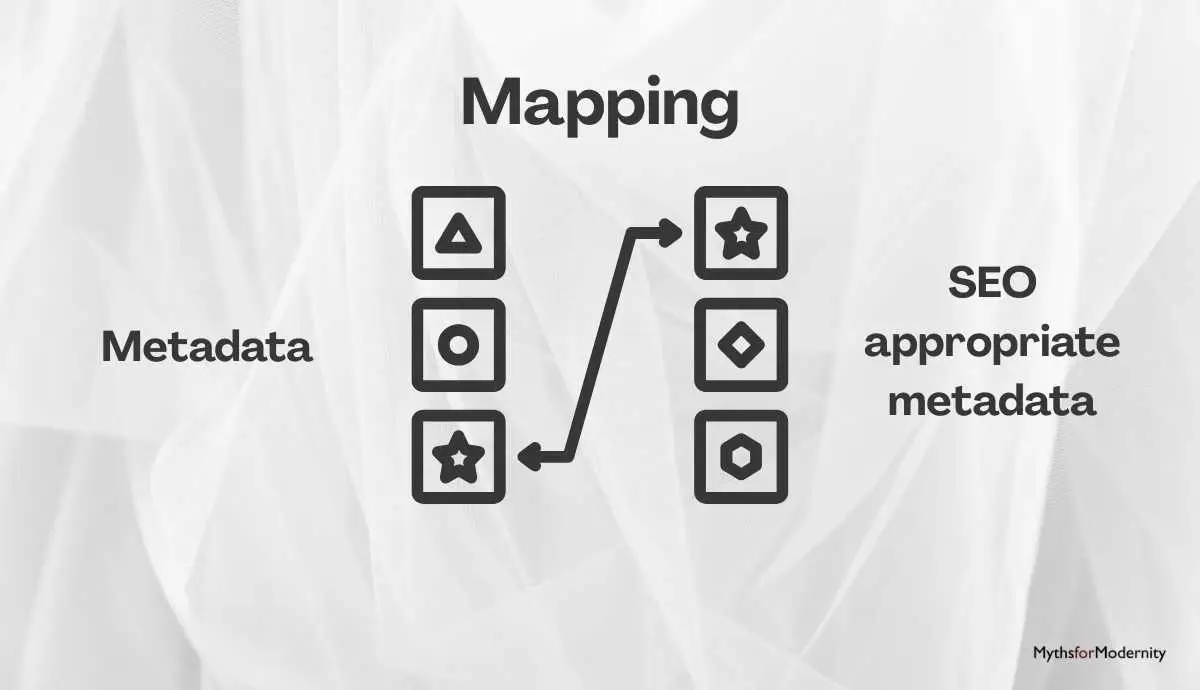
Museums typically rely on metadata standards (e.g. Resource Description Framework, MARC21, MARCXML, EAD XML DTD, METS, BIBFRAME, LIDO XML, Simple Dublin Core XML, Qualified Dublin Core XML, VRA Core 4.0 XML). These are important, but when it comes to a search engine, museums need to translate these metadata languages so that crawlers can understand them.
To be discoverable, these records must be translated into Schema.org markup, specifically using JSON-LD.
To do this a museum needs a mapping layer. For example, the Dublin Core "Creator" field should be mapped to the Schema “creator” or “author” property.
By providing this structured data, Google (or other search engines) generate "Rich Snippets" in search results. This could include the date of creation, the material, and the current exhibition status, making your entry significantly more attractive and "clickable" than a plain text link.
The Ethics of Accessibility: SEO as Digital Inclusion
Technical SEO (e.g. Page Speed, Mobile-Friendliness, and Core Web Vitals) is not always appreciated as a tool for digital inclusion. Let me explain.
Imagine you live in a location with slow internet connection and only have access to a slightly dated mobile. You try to access a museum's digital exhibition of online "accessible" collection but the page takes ages to load and when it loads the page is broken. What happened? The pages contained high-resolution images, videos, and graphic content, while they were optimized for desktop. Technical SEO shows a different path that aligns with museums' objectives.
- Optimize images for the web and minimize your code. This lowers the barrier to entry. Of course, there are ways to ensure that users can also see HQ images of the objects but what's important here is creating an entrance that is accessible to everyone, and then gradually move to more demanding "heavy" content.
- Keep it mobile-friendly. For many communities, the primary (or only) gateway to the internet is a mobile device.
- Technical efficiency also reduces the "Digital Carbon Footprint" of your institution. A leaner, faster site is a more sustainable site, aligning your digital presence with broader ethical goals.
Bibliography
- Bachiller, C., Monzo, J. M., & Rey, B. (2023). Augmented and virtual reality to enhance the didactical experience of technological heritage museums. Applied Sciences, 13(6), 3539. https://doi.org/10.3390/app13063539
- Drivas I, Vraimaki E. Evaluating and Enhancing Museum Websites: Unlocking Insights for Accessibility, Usability, SEO, and Speed. Metrics. 2025; 2(1):1. https://doi.org/10.3390/metrics2010001
- Siefkes, M., & Pfeiffer, J. A. J. (2025). Exploring Digital Exhibitions: Typologies, Design Strategies, and Visitor Engagement. Museum Worlds, 13(1), 170-176. Retrieved Apr 8, 2026, from https://doi.org/10.3167/armw.2025.130115