Greek Myths That Inspired Tolkien's Lord of the Rings
There are a few interesting parallels between Greek mythology and Tolkien's universe.
When we think of John Ronald Reuel Tolkien’s Middle-earth, we usually think of it as a Medieval-inspired world. But if you look just a little closer, there is a surprising amount of ancient Greek mythology in JRR Tolkien's universe. If you like these takes on the reception of Greek Mythology, you may also like my recent articles connecting films such as Backrooms (2026) and Obsession (2026) with various Greek myths and legends.
1. Ring of Gyges and the One Ring of Sauron
"One ring to rule them all, one ring to find them,
One ring to bring them all and in the darkness bind them."
We are all familiar with the one ring, the Ring that Gollum called its "precious". In Hobbit Tolkien tells the tale of Bilbo Baggins who finds the ring in a cave, guarded by Gollum, a strange human-like creature. Bilbo essentially steals the ring which has the power to make him invisible.
In Lord of the Rings we learn that the ring was created by the Dark Lord Sauron to contain his will and power. The ring is able to corrupt its wearer and will always seek to return to its master.
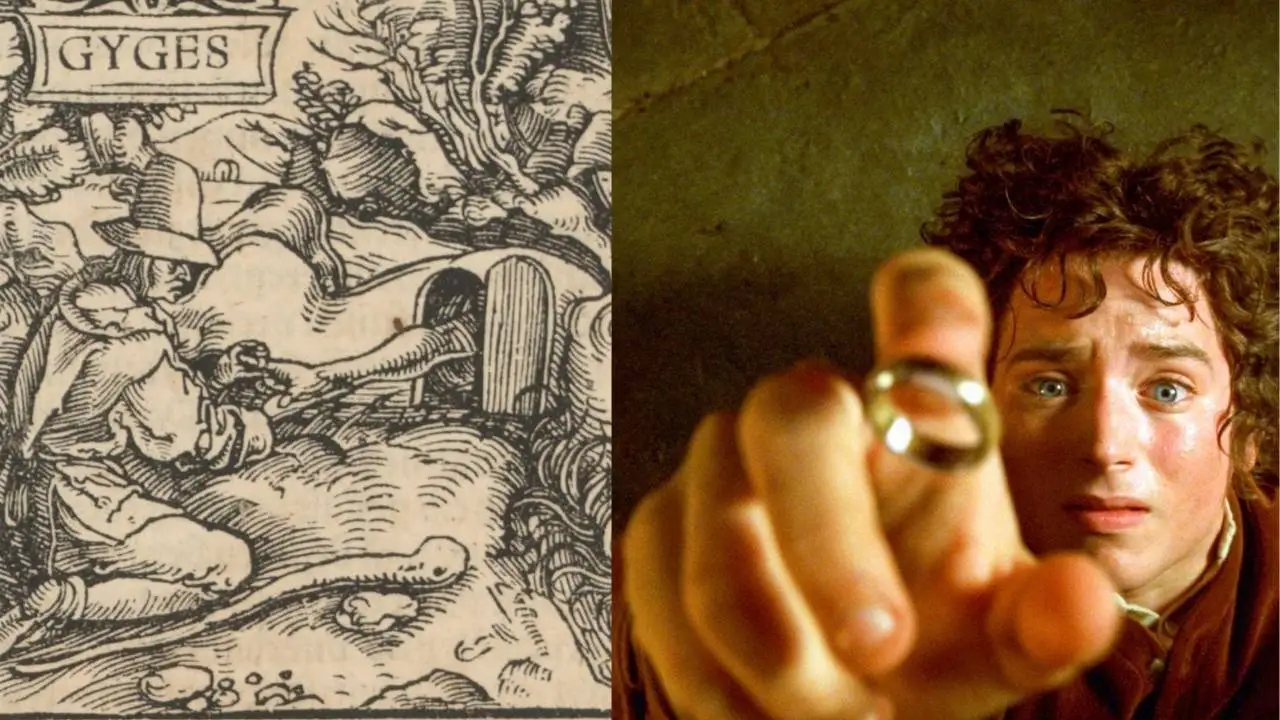
The story seems to be drawing inspiration from Book 2 of the Republic where Plato tells the story of Gyges, the shepherd who became the King of Lydia.
Gyges was outside, tending to his flock when an earthquake revealed a hidden, underground royal tomb where Gyges discovered a ring. The Ring was not ordinary as it granted him the ability to become invisible.
Gyges used the ring to seduce the queen of Lydia, murder the king, and take the throne for himself. The story is used by Plato as a thought experiment to wonder whether a human could remain moral if he was magically able to escape from public sight:
"Suppose now that there were two such magic rings, and the just put on one of them and the unjust the other; no man can be imagined to be of such an iron nature that he would stand fast in justice. No man would keep his hands off what was not his own when he could safely take what he liked out of the market, or go into houses and lie with any one at his pleasure, or kill or release from prison whom he would, and in all respects be like a god among men." (Plato, Republic 360b)
Tolkien's ring presents multiple similarities to the story of Gyges. First, in both cases we have to do with a ring that belonged to someone powerful (Sauron - unknown king). Then, the ring is hidden somewhere underground. The ring can make its bearer invisible. The ring corrupts. In Tolkien's case literally, in Plato's case it allows your darkest, most immoral instincts to surface.
In Tolkien, the ring is initially discovered by Sméagol who is corrupted and ends up commiting murder using the powers of the ring to advance his darkest wishes. However, at the end the ring's power literally turn Sméagol into a shadow of his former self, a being named Gollum whose only wish is to hold the ring and who will do anything to get it back.
Despite these thematic parallels, Tolkien scholars note that the author drew primarily from Germanic and Norse mythology such as the cursed ring of Andvari, rather than Greek philosophy. Tolkien never explicitly cited Plato as an inspiration.
2. Hesiod's Ages
In his poem Works and Days (lines 109–201), Hesiod lists five successive ages of civilization:
- Golden Age: This is the first age when Cronus and the Titans ruled the world. During this time, humans lived in peace and there was abundance of resources so work was not necessary. Humans remained young until their death and they lived far longer than the later generations.
- Silver Age: This is the new age that came when Zeus and the Olympians dethroned Cronus and the Titans. Men in the Silver Age lived for one hundred years under the protection of their mothers living like children and when they left, they were foolish and refused to sacrifice to the gods so Zeus destroyed them all.
- Bronze Age: This was the age of a violent race of human who were fond of war and wore armor of bronze. This age is also sometimes known as the Copper Age or Brazen Age.
- Heroic Age: The heroes of this Age were the great heroes of Homer and other cycles of Greek mythology such as the Theban. This was an age of greatness.
- Iron Age: This is the age of Hesiod. During this age, all laws are broken. Children dishonor parents, hosts do not honor their guests, and siblings fight each other in a world ruled by violence. Zeus will end this age when humans begin to be born with gray hair .
Tolkien is not mirroring these ages exactly but he presents four ages that become less and less "glorious" with each successive age. A key idea is that the elves (the most noble race of all) abandons the Middle Earth completely by the fourth age.
- First Age: Awakening (creation) of Elves and Men. The age ends with the fall of Morgoth.
- Second Age: This age ends with the first fall of Sauron (Morgoth's servant) and the drowning of Númenor.
- Third Age: This is the age where the events of the Lord of the Rings take place. The age ends with Sauron's second and final fall and the destruction of the one ring. The elves depart from Middle-earth.
- Fourth Age: During this age, humans dominate Middle Earth as all other intelligent races like the Elves and the Dwarves disappear.
3. Cronus-Zeus and Morgoth-Sauron
Cronus was the king of the Titans (deities that came before the Olympians). His son, Zeus, overthrew him in a violent war called the Titanomachy. Zeus became the king of the gods and Cronus was sent as a prisoner to the Tartarus, the deepest and darkest pit of the underworld.
Morgoth suffers a similar fate in Silmarillion. Morgoth corrupts a spirit (Maia) named Mairon to become his servant under the name Sauron. However, Morgoth is eventually defeated by the other gods, the Valar, and banished in a void of nothingness with his hands and legs compromised. Sauron takes his master's place and rules in his stead as the new dark lord.
4. Nymphs and the Ents
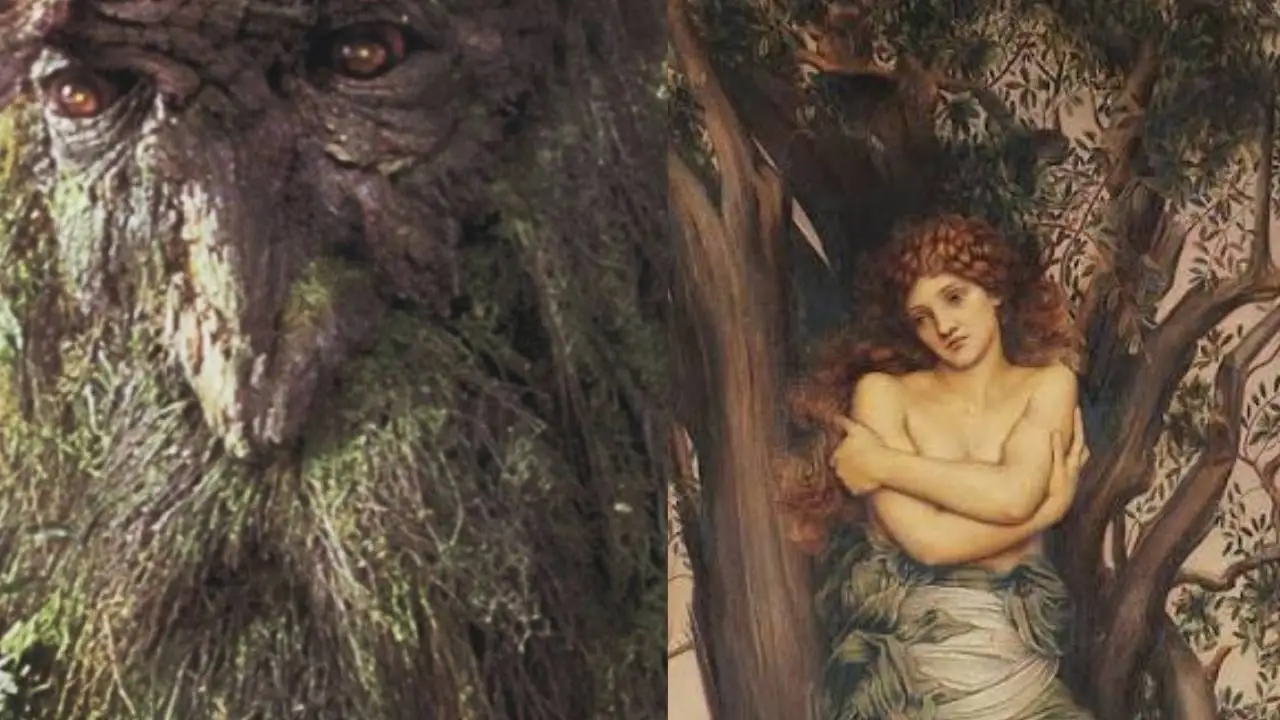
Kind of an obvious one, but in Greek myth trees were inhabited by female spirits, the nymphs. Depending on the tree types they occupied the nymphs had different names.
In the Lord of the Rings universe, trees are seen as sacred and we even come across the Ents, giant tree beings who live and protect the forests. However, the connection is a very loose one and Tolkien was mainly inspired by Northern folklore where trees were also sacred. The term ent even derives from Old English and translates to giant.
Also Tolkien has stated that he thought of the Ents as trees going to war after being frustrated with William Shakespeare's play Macbeth where a prophecy suggests that:
"Macbeth shall never vanquished be until Great Birnam Wood to high Dunsinane Hill shall come against him."
In Shakespeare the prophecy is a metaphor for an army concealed with branches cut from the Great Birnam Wood. Tolkien didn't like this and wanted a story where a Forest actually went to war.
5. Isles of Makaron and the Elven Lands
The Isles of the Blessed (aka Isles of Makaron) were sort of the Greek version of Paradise, a winterless, green island where the souls of heroes and those who lived a good life would end up.
In Tolkien's world, there was a land of undying beauty off the Western coast of the Middle Earth. This is Valinor, a place where the immortal elves live a blessed life near the gods. In the end of Lord of the Rings, that's where Frodo goes with the last of the elves.
6. Atlantis and Numenor
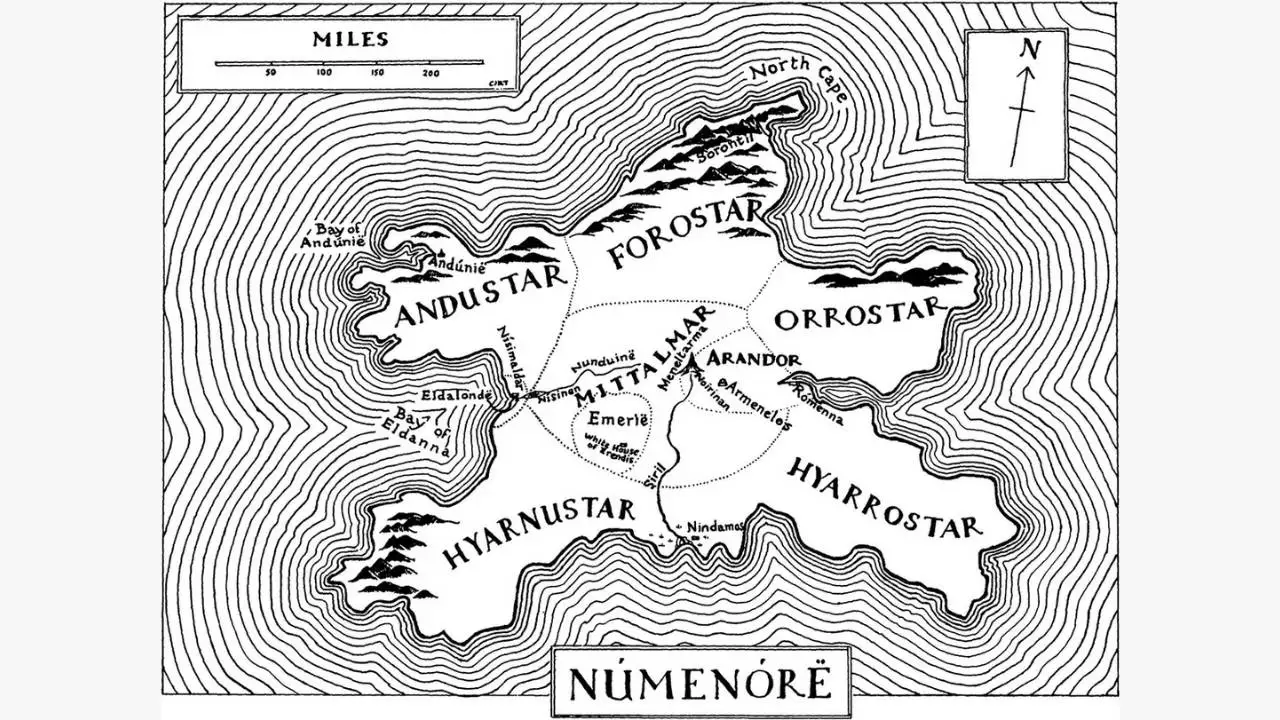
A great island civilization that was ages in front of the rest of the world. Their technology was advanced, their army powerful.
But then, suddenly a great flood came and the island was swallowed by the ocean. Now the civilization has completely vanished and only stories of its existence are left.
There is no doubt that Tolkien's Numenor is based on Plato's Atlantis as he describes it in Timaeus and Critias. Here is a passage from the former:
...a mighty power which unprovoked made an expedition against the whole of Europe and Asia, and to which your city put an end. This power came forth out of the Atlantic Ocean, for in those days the Atlantic was navigable; and there was an island situated in front of the straits which are by you called the Pillars of Heracles; the island was larger than Libya and Asia put together, and was the way to other islands, and from these you might pass to the whole of the opposite continent which surrounded the true ocean; for this sea which is within the Straits of Heracles is only a harbour, having a narrow entrance, but that other is a real sea, and the surrounding land may be most truly called a boundless continent. Now in this island of Atlantis there was a great and wonderful empire which had rule over the whole island and several others, and over parts of the continent, and, furthermore, the men of Atlantis had subjected the parts of Libya within the columns of Heracles as far as Egypt, and of Europe as far as Tyrrhenia. This vast power, gathered into one, endeavoured to subdue at a blow our country and yours and the whole of the region within the straits; and then, Solon, your country shone forth, in the excellence of her virtue and strength, among all mankind. She was pre-eminent in courage and military skill, and was the leader of the Hellenes. And when the rest fell off from her, being compelled to stand alone, after having undergone the very extremity of danger, she defeated and triumphed over the invaders, and preserved from slavery those who were not yet subjugated, and generously liberated all the rest of us who dwell within the pillars. But afterwards there occurred violent earthquakes and floods; and in a single day and night of misfortune all your warlike men in a body sank into the earth, and the island of Atlantis in like manner disappeared in the depths of the sea. For which reason the sea in those parts is impassable and impenetrable, because there is a shoal of mud in the way; and this was caused by the subsidence of the island. (Plato, Timaeus)
7. Valar to the Olympian Pantheon
There are quite a few similarities in the way Tolkien describes his pantheon to Greek myth. Here is a table summary of notable connections:
| Greek God | Valar | Realm |
| Zeus | Manwe | Air/Sky, King of Gods |
| Poseidon | Ulmo | Water/Ocean |
| Hephaestus | Aule | Smithing |
| Artemis | Orome | Hunt/Forests |
| Hades | Mandos | Govern realms where the souls of dead end up |
8. Beren and Luthien - Orpheus and Eurydice
According to Tolkien, his lesser known work Beren and Luthien was sort of a re-reading of the myth of Orpheus and Eurydice with the genders swapped. In both cases love is the central theme and one of the protagonists must descend to the realm of the dead to bring their love back.
Also read: