The Trap of Thucydides Has Nothing to Do With the Greek Historian
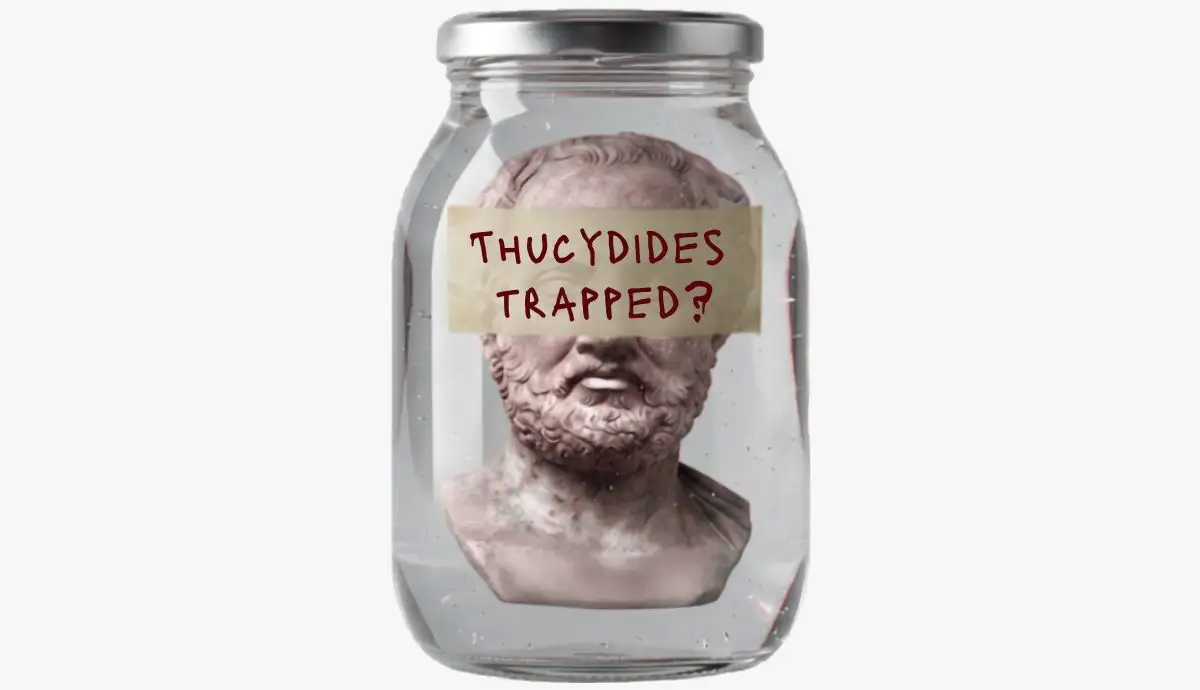
The so-called "trap of Thucydides" is based on a misreading of Thucydides who may have been warning us about a dangerous self-fulfilling prophecy.
Summary
- The Thucydides Trap is a political theory claiming war is inevitable when a rising power threatens an established one.
- This theory may be based on a misinterpretation of Thucydides, with unexpected implications.
In May 2026, the Chinese president Xi Jinping met the president of the US and in his opening statement wondered if it is possible for China and the USA to transcend the Thucydides Trap. Interestingly, the trap is much more dangerous than you think but not for the reasons the chinese president implied. So what is this trap and what is its relation to the ancient Greek historian Thucydides?
Leave Thucydides alone?
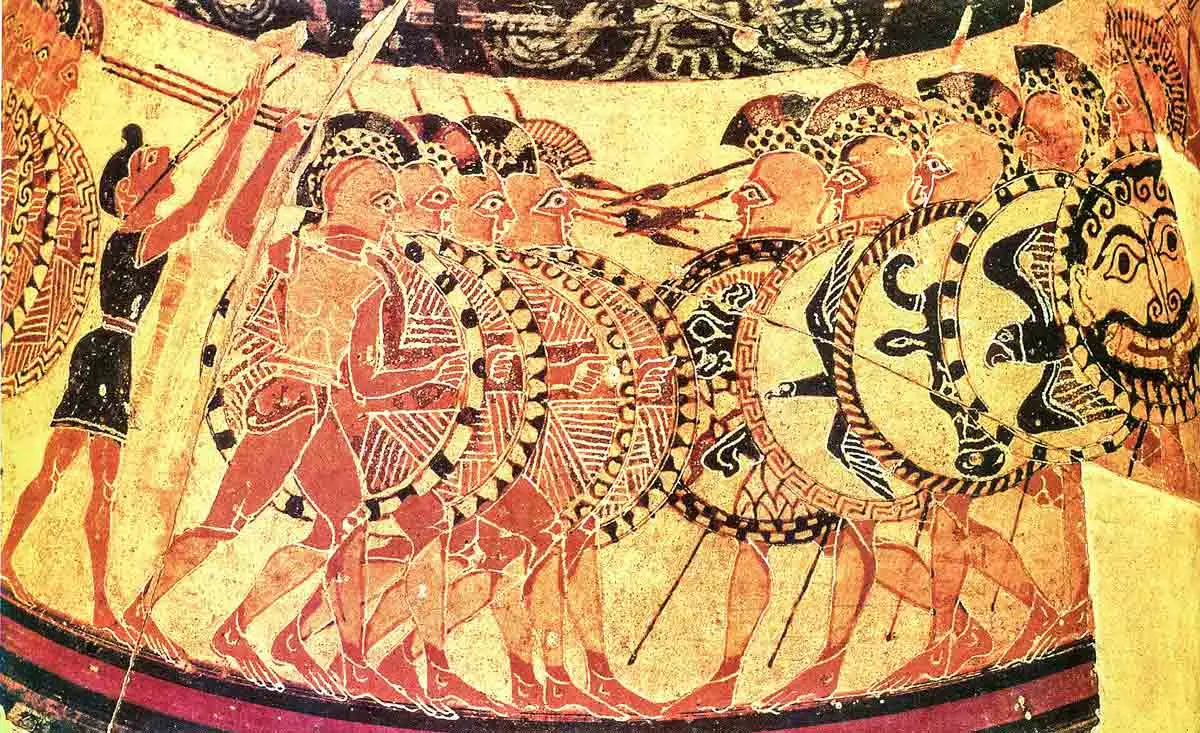
In his work titled I Greci e I Romani ci salveranno dalla barbarie (2023), classical historian Giusto Traina presents a case for a different approach to classical studies, an approach that among others is concerned with the way the classical heritage is appropriated by different discourses. The book is an interesting take on classical reception examining the memory and use of the classical past in contemporary political and cultural discourse.
Among the examples is the so-called trap of Thucydides which the author treats as a modern misreading of Thucydides:
"Let's accept it... the trap of Thucydides became an International Relations formula, a phrase with its own life that has little to do with Thucydides and the context of the Peloponnesian War. And many still ignore the clear warning of the Canadian political scientist David Welch who recommended that his colleagues leave Thucydides alone forever." (Traina 2023; the English translation is mine)
But what is this Thucydides trap and why does Traino think it has little to do with the man himself, Thucydides?
What is the trap of Thucydides?
Definition: The Thucydides trap is a theory that posits that when a great power's hegemonic position is threatened by an emerging power, war becomes inevitable.

The concept was first introduced by the American novelist Herman Wouk in 1980. Wouk used the term to describe the relationship between the USA and the USSR:
And more than two millennia later we seem still trapped in Thucydides' world. None of the ways in which those quarrelsome Greeks behaved is suited to these dread times of nuclear menace; yet we still behave in those ways, and can find no other. How do we break out of this Thucydidean trap, which now threatens to strangle, if not to destroy, our world? (Wouk 1980)
The term was popularized in the 2010s by the American political scientist Graham Allison who used it for the relationship between the USA and China; a case that remains popular in current political discourse.
In Destined for War: Can America and China Escape Thucydides’s Trap? (2017), Allison examined 16 cases since the 1500s where a new power rose and found that 12 cases ended in war with established powers.
| Period | Ruling Power | Rising Power | Result |
| Late 15th C. | Portugal | Spain | No War |
| 17th C. | France | Hapsburgs | War |
| 16th-17th C. | Hapsburgs | Ottoman Emppire | War |
| 17th C. | Hapsburgs | Sweden | War |
| 17th C. | Dutch Republic | England | War |
| 17th-18th C. | France | Great Britain | War |
| 18th-19th C | UK | France | War |
| 19th C. | France & UK | Russia | War |
| 19th C. | France | Germany | War |
| 19th-20th C. | China & Russia | Japan | War |
| 20th C. | UK | USA | No War |
| 20th C. | UK, France, Russia | Germany | War |
| 20th C. | USSR, France, UK | Germany | War |
| 20th C. | USA | Japan | War |
| 20th C. | USA | USSR | No War |
| 20th C.-present | UK & France | Germany | No War |
If you are interested in the 16 cases that Allison investigated, you can find more information at this page by Harvard's Belfer Center for Science and International Studies.
What's the connection to Thucydides?
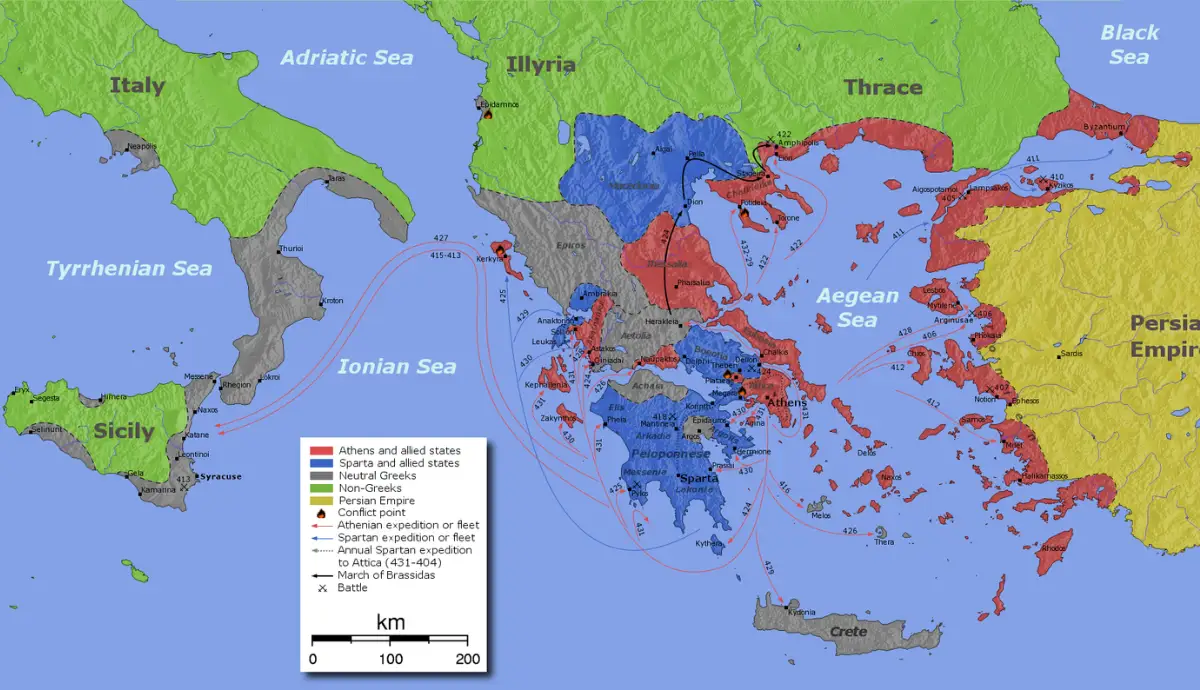
In The History of the Peloponnesian War, Thucydides writes about the war between Athens, Sparta, and their respective allies. In the first chapter, Thucydides seeks the real causes of the destructive conflict that left the Greek world in shambles:
"The real cause I consider to be the one which was formally most kept out of sight. The growth of the power of Athens, and the alarm which this inspired in Lacedaemon [Sparta], made war inevitable." Thuc. 1.23.6
So, for the Greek historian, it seems, the two city-states fought because Athens's power was growing at a pace that the hegemonic power of Sparta could not ignore lest it risked its dominant position.
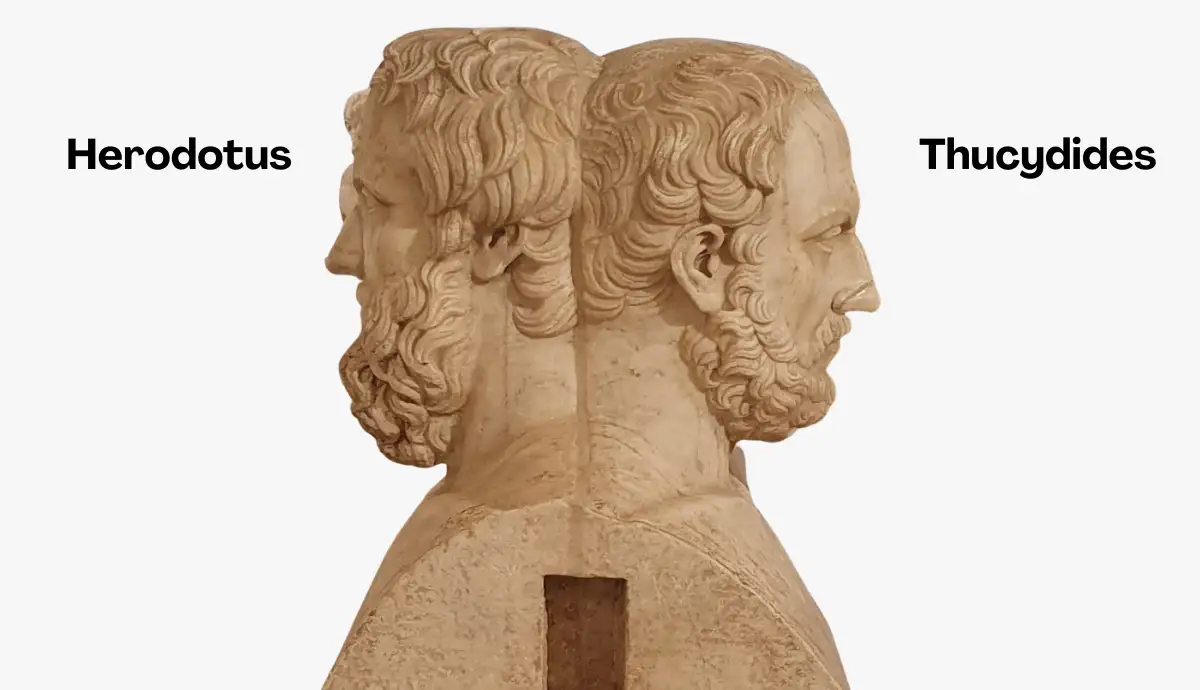
It is exactly this point that has made Thucydides a favorite for political theorists and the father of the so-called "political realism" and power politics.
Unlike Herodotus who described the Greco-Persian wars as a war of cultures (East vs West, Greeks vs barbarians), Thucydides explains that the Peloponnesian War was the result of a power struggle; an invisible force underlying political action .
But...
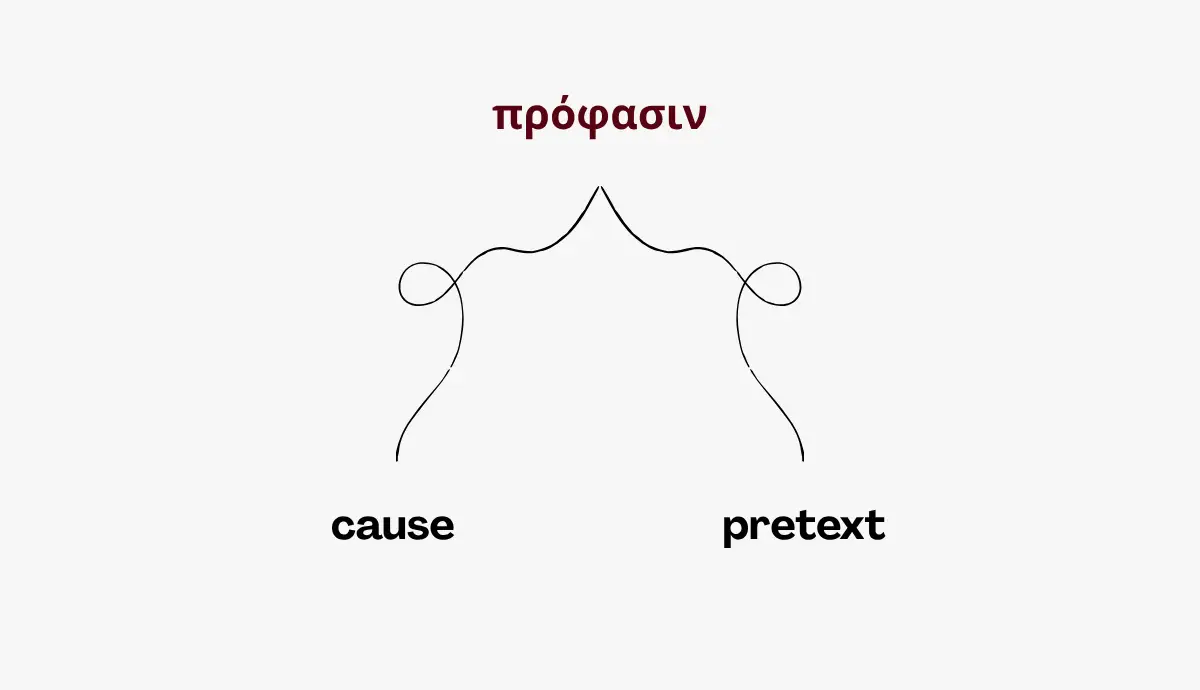
But, there is one problem. This translation of Thucydides's passage may not capture the true spirit of what he meant.
A popular translation from 1910 is the one by Richard Crawley which is popular on the web:
The real cause I consider to be the one which was formally most kept out of sight. The growth of the power of Athens, and the alarm which this inspired in Lacedaemon [Sparta], made war inevitable.
and here is the version of Thomas Hobbes from his 1628 translation:
And the truest quarrel, though least in speech, I conceive to be the growth of the Athenian power, which putting the Lacedaemonians into fear necessitated the war.
According to a convincing article by Sutton (2025), the passage of Thucydides is more ambiguous than its English translation allow us to think. Before we look at Sutton's arguments let's look at the Greek version of 1.23.6:
τὴν μὲν γὰρ ἀληθεστάτην πρόφασιν, ἀφανεστάτην δὲ λόγῳ, τοὺς Ἀθηναίους ἡγοῦμαι μεγάλους γιγνομένους καὶ φόβον παρέχοντας τοῖς Λακεδαιμονίοις ἀναγκάσαι ἐς τὸ πολεμεῖν...
Sutton draws attention to and re-examines the following terms:
- "ἀφανεστάτην" is often translated as "invisible", but "least apparent" or "least talked about" is a more appropriate translation.
- "ἀφανεστάτην δὲ λόγῳ" is commonly translated as the "invisible reason/cause", but with the term "λόγῳ" Thucydides may be actually referring to rhetorical speeches (λόγους).
- In his history, Thucydides presents a series of cases where hostilities could have been avoided but everytime, a speech escalates tension by presenting the war as inevitable. Thucydides seems to argue that these speeches acted as self-fulfilling prophecies. By talking about the war as inevitable they actually made the war happen.
- Now let's focus on another term. "ἀληθεστάτην πρόφασιν", is usually translated as the "truest reason/explanation" but it could just as easily be translated as "truest pretext" which is another meaning of "πρόφασιν". Therefore πρόφασιν could mean either or both of the below:
- The truest pretext given (before the war started, by certain characters) was this one: the growth of Athenian power and the fear that instilled in the Spartans forced them into the war.
- The truest explanation (in retrospect, from the historian’s perspective) was that the growth of Athenian power and the fear that instilled in the Spartans forced them into the war.
Therefore, Sutton (2025) proposes a different understanding of Thucydides's famous passage (1.23.6) with a completely different meaning than the one that led to Allison's case.
For I think that the truest explanation, though the one least obvious in speech, is that the growth of Athenian power and the fear that instilled in the Spartans forced them into fighting. But these were the reasons clearly articulated on each side, from which, after breaking their treaties, they established a state of war. (Sutton 2025, 8)
If this is what Thucydides actually meant then a whole new danger becomes apparent, a new sort of Thucydides trap that we (the Chinese president included) have already fallen into.
The Thucydides trap no one saw coming

So if Thucydides meant that distrust and fear actually caused the war and that the truest pretext was that politicians believed that war was inevitable so it became inevitable, then talking about the Thucydides trap is the real trap.
By talking about an inevitable war of superpowers we make it inevitable. This discourse facilitates distrust and paves the way for a conflict that is due to happen because of a quasi-religious belief in an "invisible law of power" that dictates that a rising power is more likely to go to war with a ruling power than to avoid it.
However, it is easy to imagine someone arguing that "even if Thucydides was mistranslated, this doesn't mean that the trap is not real. The data speaks for itself. 12/16 cases end up in war".
Now we are entering an area that is not my field, but I would like to ask this person two things.
- The current superpowers believe that they are reenacting an Athens vs. Sparta scenario underpinned by an ancient law of power. If Thucydides points to a peaceful resolution of this scenario (a scenario that bears his name nonetheless!) that must be something important, isn't it?
- Allison's theory seems difficult to verify and as many have pointed out, it seesm that who is described as the ruling and who as the rising power is arbitrary. For example, the EU is, even if many will disagree, a superpower, and its rise during the past century was facilitated, not prevented, by the US, another superpower. Also in some of Allison's examples it is not clear why certain powers were chosen. For example in WWII, why is the USSR grouped with the UK and France as a ruling power and Germany as a rising one? We could easily argue that the USSR was just as rising as Germany.
So it seems to me that Thucydides was right but not in the way that many international theorists would want him to be. Superpowers are not destined to fight each other trapped by an invisible power driving to an inevitable conflict. It's the belief in the inevitability of the war that makes the war inevitable. It's all a self-fulfilling prophecy, and a very dangerous one.
To wrap this up, I would like to close with a quote from David Welch's article "Why International Relations Theorists Should Stop Reading Thucydides" (2003) where the political theorist explains that Thucydides at the same time tells us a lot about the complexities of his time but does not provide a universal framework that we can rely on. At the end, Thucydides can teach that International Relations are, just like the subjects he presents in his history, much more complex than we would like them to be:
...the story Thucydides tells us would help us better understand, I believe, that international politics is primarily about choices, not constraints...I believe we would see that questions of morality and justice between states are perennially open, cannot be silenced, and are not answered by dismissive aphorisms such as ‘might makes right’ or ‘the strong do what they can and the weak suffer what they must’ with which Thucydides has been unfairly saddled. Treated respectfully, in other words, Thucydides may be the very remedy we need for the damage he unwittingly wrought.
Bibliography
- Allison, G. 2017. Destined For War. London.
- Lamb, K. 2026. "What is the Thucydides Trap and why did Xi Jinping mention it in his meeting with Donald Trump?" TheGuardian. https://www.theguardian.com/us-news/2026/may/15/thucydides-trap-explained-xi-jinping-donald-trump-us-china-taiwan
- Sutton, D. 2025. Thucydides’ Ambiguous Trap. Classical Antiquity 44 (2): 352–385. doi: https://doi.org/10.1525/ca.2025.44.2.352
- Wouk, H. 1980. "SADNESS AND HOPE: SOME THOUGHTS ON MODERN WARFARE: A lecture given on 16 April 1980 at the Naval War College". Naval War College Review. 33 (5): 4–12.
- Welch, D. A. (2003). Why International Relations theorists should stop reading Thucydides. Review of International Studies, 29(3), 301–319. doi:10.1017/S0260210503003012
Also read: