Do "Hard Times Create Strong Men"? What Herodotus and Ibn Khaldoun Say
The historical roots behind the quote "Hard times create strong men." How Herodotus, Hesiod, and Ibn Khaldun viewed the cycle of empires.
Key Takeaways
- The "hard times create strong men" trope stems from cyclical historical theories going back to Herodotus.
- These theories are historically inaccurate and rely on confirmation bias.
- Today, far- and alt-right groups weaponize this narrative.
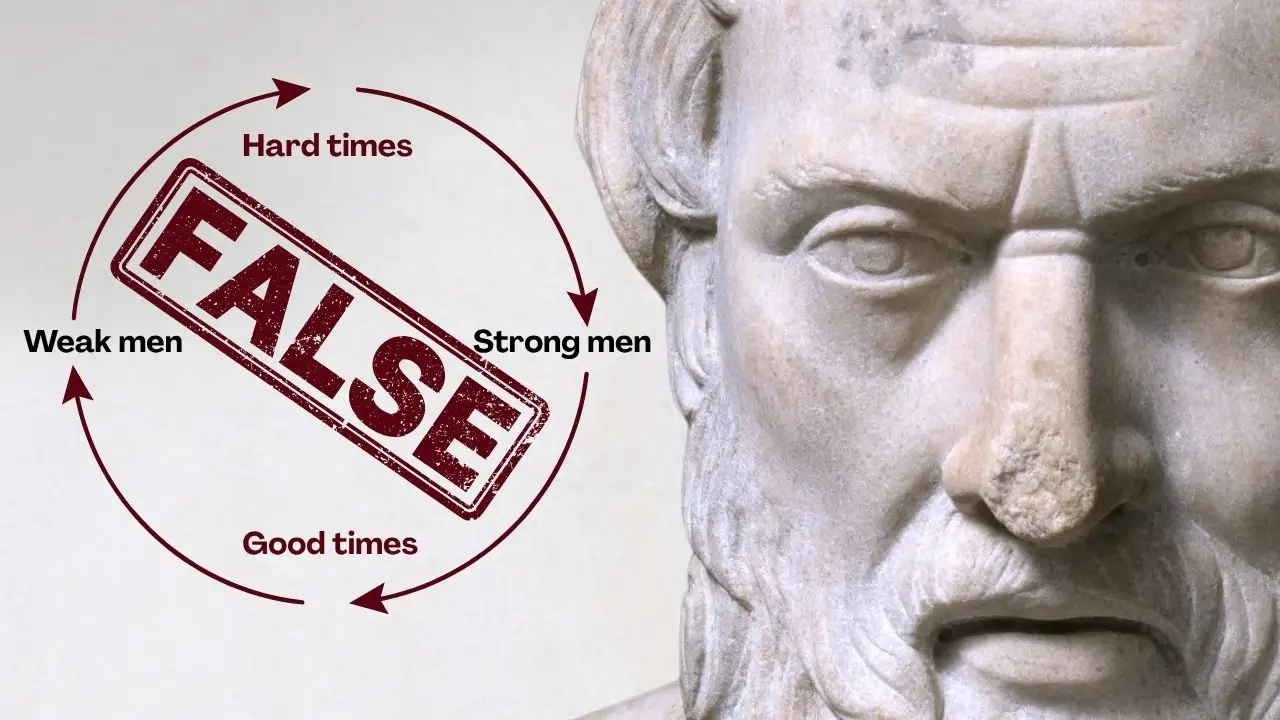
"Hard times create strong men, strong men create good times, good times create weak men, and weak men create hard times". You have surely seen this quote somewhere on the internet. Apparently it comes from the 2010 novel Those Who Remain by G. Michael Hopf, but it's meaning goes way back. Herodotus seems to argue something along those lines and Ibn Khaldun believed that empires follow a cycle of rise and fall.
Herodotus: "Soft lands breed soft men"
In Herodotus' Histories (9.122), the father of history presents an interesting concept. Right after Cyrus the Great had established his grand empire, he is approached by a group of Persians who ask him to move the Persians to better lands now that they rule Asia:
Seeing that Zeus grants lordship to the Persian people, and to you, Cyrus, among them,... let us now remove out of the little and rugged land that we possess and take to ourselves one that is better. There be many such on our borders, and many further distant; if we take one of these we shall have more reasons for renown. It is but reasonable that a ruling people should act thus; for when shall we have a fairer occasion than now, when we are lords of so many men and of all Asia?"
Cyrus however is not eager to do so.
"Do so, but if you do, make ready to be no longer rulers, but subjects. Soft lands breed soft men; wondrous fruits of the earth and valiant warriors grow not from the same soil."
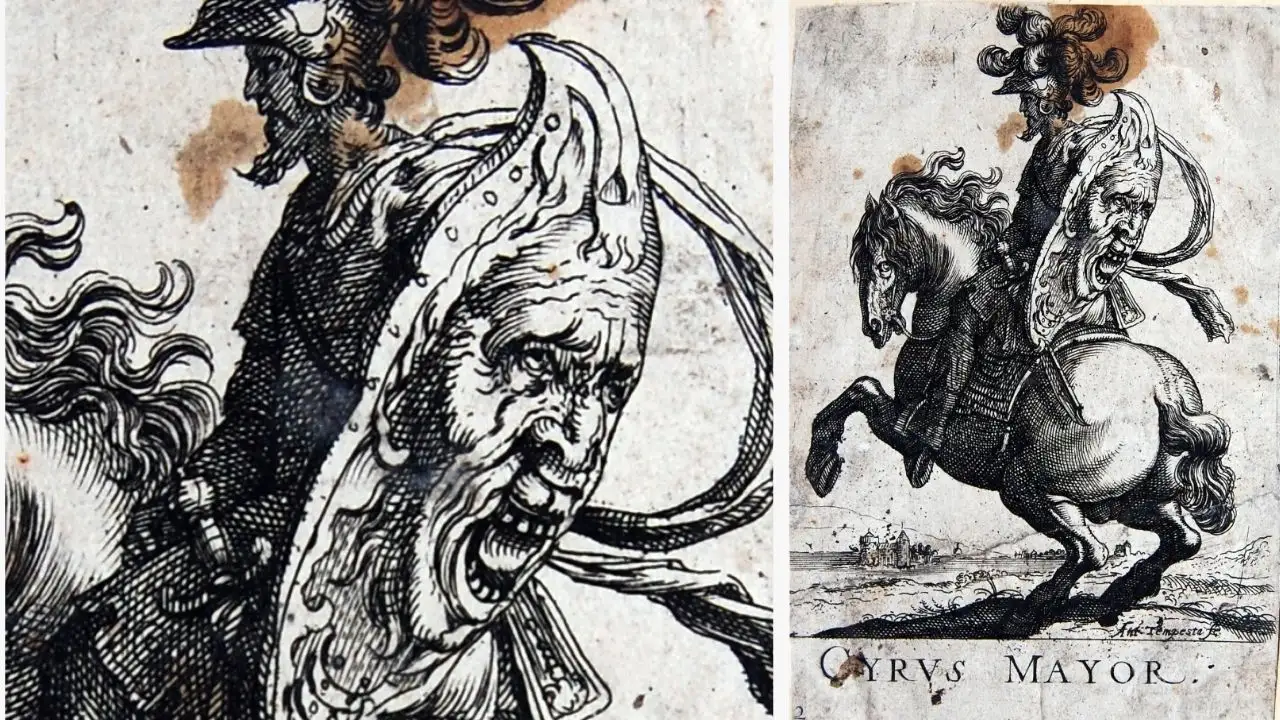
The idea here is simple. Adverse conditions breed strong fighters. Luxurious and comfortable lifestyles breed weak civilizations that are easy to conquer.
The Persians finally listen to Cyrus' advice which Herodotus treats as a wise insight. Yet Cyrus' is not a cyclical of rise and fall narrative. The Persian king's wisdom suggests that one can maintain power by making the right choices and avoiding a life of luxury that turn strong fighters into softies.
Hesiod's Ages
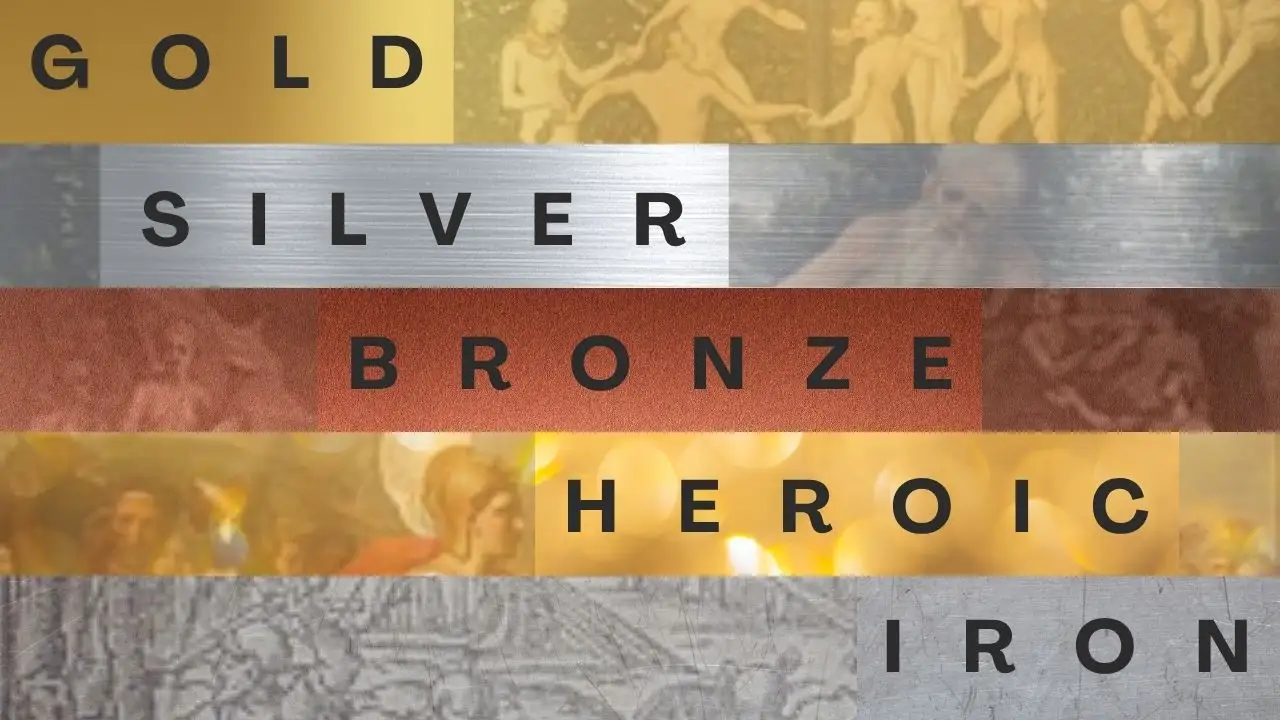
In Works and Days (lines 109–201), the Greek poet Hesiod lists five successive ages of civilization:
| Golden Age | This is the first age when Cronus and the Titans ruled the world. During this time, humans lived in peace and there was abundance of resources so work was not necessary. Humans remained young until their death and they lived far longer than the later generations. |
| Silver Age | This is the new age that came when Zeus and the Olympians dethroned Cronus and the Titans. Men in the Silver Age lived for one hundred years under the protection of their mothers living like children and when they left, they were foolish and refused to sacrifice to the gods so Zeus destroyed them all. |
| Bronze Age | This was the age of a violent race of human who were fond of war and wore armor of bronze. This age is also sometimes known as the Copper Age or Brazen Age. Heroic Age: The heroes of this Age were the great heroes of Homer and other cycles of Greek mythology such as the Theban. This was an age of greatness. |
| Heroic Age | This is the only age that improves upon the previous one. This is an age of heroes and demigods. The age of Troy, Oedipus, and Cadmus. |
| Iron Age | This is the age of Hesiod. During this age, all laws are broken. Children dishonor parents, hosts do not honor their guests, and siblings fight each other in a world ruled by violence. Zeus will end this age when humans begin to be born with gray hair . |
Hesiod symbolically names each successive age after metals of diminishing value. In Hesiod's system, as the ages get increasingly more difficult and the conditions more harsh, humans live worse lives.
Hesiod's system is one guided by divine powers. The gods decide when an age ends and a new one begins.
Hesiod's linear historical time was also adapted by Roman authors, notably Ovid, and inspired modern periodization (with its Ages of Stone, Bronze, and Iron), and even the four ages of JRR Tolkien's legendarium.
Ibn Khaldun on how empires rise and fall
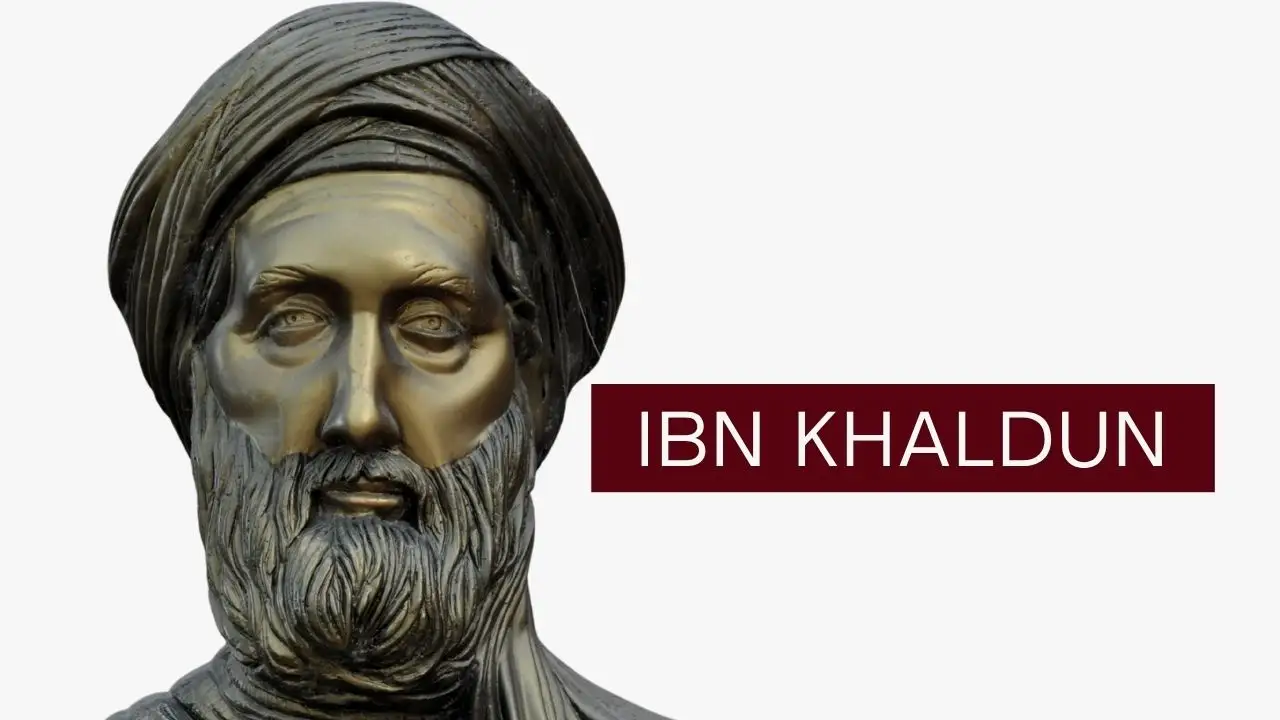
Abu Zayd ‘Abd al-Rahman ibn Muhammad ibn Khaldun al-Hadhrami was a 14th century Arab historian with some truly original ideas.
In Muqaddimah (1377), Ibn Khaldun put forward a theory based on the concept of Asabiyyah, a kind of group solidarity based on blood ties and common struggles.
For Khaldun groups with strong Asabiyyah tend to conquer those with a looser one. High rates of Asabiyah mean that a group can collectively overcome difficulties, face adverse conditions without breaking, and subordinate the interests of the individual to those of the collective.
For Khaldun all sovereign empires have a lifespan of circa 120 years and pass through five successive stages.
| 1.The Foundation | Stage of success, strong asabiyya, bond of lineage, uncivilized society, high chivalry, competent fighters, the importance of dignity and pride, unworthy of wealthy, a leader which is the first among equals and with limited power, heroism, high loyalty to leader, the strong obedience to tradition and religion, badawa period (rural life), taking the full control of subjects and the obedience of subjects, starting collecting tax, sending envoys to other states, defending its own borders (soldier superiority), no stronger power in its own land |
| 2. The personalization of power | A leader with absolute power, the beginning of asabiyya of reason, professional army, the desire of individual loyalty just for a leader |
| 3. The growth and expansion (Leisure and tranquility time) | Leisure and tranquility, big achievements in architecture, literature, science and art, the beginning of hadara (urban life), no threat from outside or inside, wealthy state, tax and agricultural regulations, new laws, the beginning of luxury life, the strongest level of the state, supporting arts and science and crafts, artistic development, sharing the money with subjects, the efforts to flourish a state, strong economy, general welfare |
| 4. Stagnation (Satisfaction and peacefulness time) | Satisfaction and peacefulness, the leaders desiring to imitate their ancestors’ actions, longing for the past, inexperienced leaders with weak characters, incompetent bureaucracy, the desire of luxury, lack of courage, unwillingness to war, comfortable life, lavish lifestyle, money desire, reached natural borders, bad habits. |
| 5. The decline and dissolution (Waste and squandering time) | Waste and squandering, a state with senility disease, lack of money, unfaithful soldiers, unmoral lifestyle, imitating stronger states, blaming for ancestors’ actions, lack of stronger asabiyya to keep a state under control and to defend |
Note: the table is sourced from Onder and Ulasan (2018).
In many ways, Khaldun's system is similar to the vision presented by Herodotus' Cyrus but with major differences. For once, Khaldun is very thorough and systematic. His theory is coherent and attempts a unique sociological study of empires and human societies.
For Khaldun what makes a successful empire is Asabiyah, and it's exactly its loss that leads to decline alongside other factors such as overtaxation and addiction to luxury.
Do Hard Time Create Strong Men?
Khaldun's theory is deterministic. Every empire that rises is doomed to fall. It is striking how easy it is to find exceptions to Khaldun's rules of the five successive stages and the 120 lifespan, like Ancient Egypt, China, and even the Roman Empire whose Eastern half survived for 1000 years. It is evident that Khaldun's theory suffers from confirmation bias. Simply put, Khaldun searches through history for cases that confirm his beliefs and completely neglects all the many cases that disprove it.
Similarly, Herodotus' Cyrus expresses a view that at first glance appears wise, but upon a second look is baffling. History offers plenty of counter-evidence. The Roman Empire, for example, rose from the ashes of the Republic and reached its territorial peak with Trajan's expansions. These conquests were neither the result of pure, unified solidarity nor a "strong" race of men conquering soft nobles who had forgotten how to fight. The Romans were at the absolute peak of their wealth, and their empire was heavily divided from within.
However, merely disproving Herodotus, Hesiod, or Khaldun's historical accuracy isn't the most pressing issue. It is far more revealing to examine who relies on the "hard times create strong men" narrative in the modern world. In the digital realm, you will find these words repeated endlessly by far-right individuals and groups.
Their narrative is clear: the generation that fought in the difficult years of WWII and the Cold War was a strong generation that created good times. Western liberal democracies have since focused too much on rights; western societies have become too comfortable for their own good.
This is often paired with a homophobic or racist rhetoric: "Send him to Dagestan for a month, and he'll return a man," or, they wouldn't get away with that in their home country."
Proponents of these ideas think that the West is crumbling, and tolerant societies are at fault. Therefore, some sort of new "strength" is required. While they leave the definition of strength deliberately vague, the implications are straightforward. Look at how these groups idealize violence and look back at the past, be it Classical antiquity, the Medieval era, Colonialism, or the 20th century, with nostalgia.
Behind the narrative that hard times create strong men, lurk the ghosts of fascism and totalitarianism.
Ultimately, Herodotus, Hesiod, and Ibn Khaldun have nothing to do with these modern ideas.
Bibliography
- Önder, M., & Ulaşan, F. (2018). IBN KHALDUN’S CYCLICAL THEORY ON THE RISE AND FALL OF SOVEREIGN POWERS: THE CASE OF OTTOMAN EMPIRE. Adam Academy Journal of Social Sciences, 8(2), 231-266. https://doi.org/10.31679/adamakademi.453944